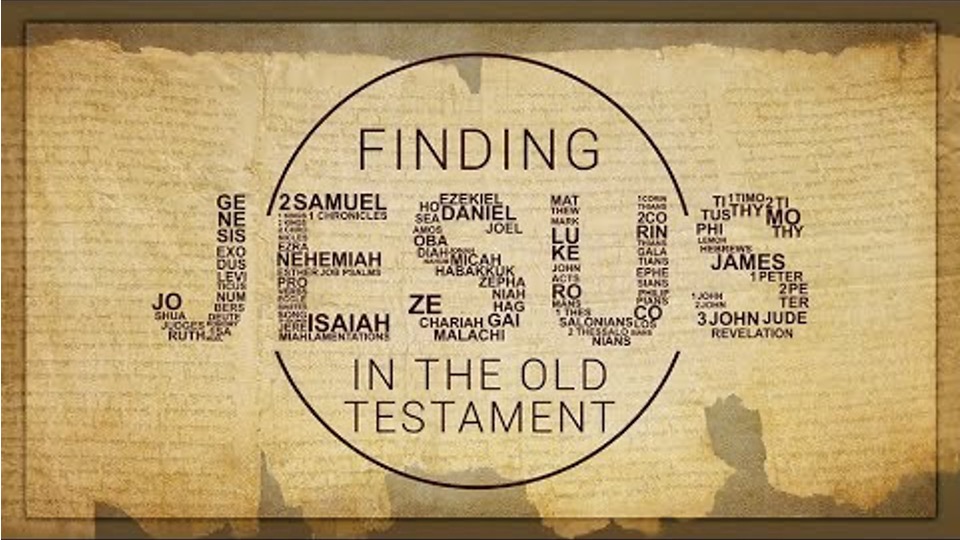
One of the things that I think is important within the Gospel of Jesus Christ is to make Christ the centre of everything that we do and everything that we are. Probably the scripture that has influenced me most 2 Nephi 25:26 which says:
And we talk of Christ, we rejoice in Christ, we preach of Christ, we prophesy of Christ, and we write according to our prophecies, that our children may know to what source they may look for a remission of their sins.
This scripture that has influenced everything that I have done over the last nearly 40 years, since I joined the Church. Christ is the centre of everything; I think sometimes and this may sound strange, but sometimes we can miss Christ in the various things that we do, because we are so wrapped up what we’re doing or focussing on. It could be family history, the Temple, or anything else. Because we make that thing our focus, we miss Christ. As we explore finding Christ or finding Jesus in the Old Testament it’s him that’s front and centre.
I teach, I talk about, I write about religions of the world, and I have done that since I left to go to university at the age of 20. I’d served my mission, I’d come home and I went away to University at Chester. After I’d been at Chester for a couple of months my mum was approached at church by a lovely old lady who said: “we’re worried about Jimmy, we’re worried he’s gonna lose his faith.” The reason that they were worried that I was gonna lose my faith is that I was learning about other religions; I was studying Christian theology, I was doing all kinds of things that they’d never encountered before from a member of the Church.
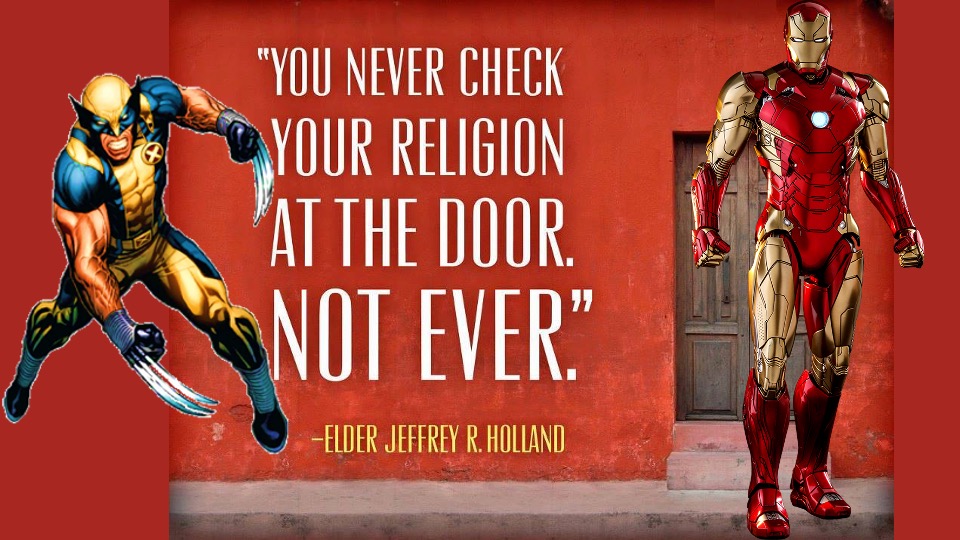
One of the important things that I have learned, and I have tried to live by is highlighted by Elder Holland who said, “you never check your religion at the door, not ever.” In all my studies the gospel of Jesus Christ and my relationship with the Saviour have been central. It is important that we don’t ever sacrifice or explain away those things that lie at the heart of who we are. Our faith is a part of who we are. We are promised that in donning the armour of God and living with faith, we have a hope of salvation. We should prepare for each day through study and prayer, keeping ourselves physically, mentally and spiritually healthy, and following the promptings of the Lord in living a righteous life; in so doing we will have the Holy Ghost poured down upon us. My faith is an integral part of who I am. As a disciple of Christ my discipleship should infuse every aspect of my life. I strive to keep the armour of God moulded to me- I view it more as Wolverine’s adamantium which is welded to his bones, rather than Iron Man’s suit which is a bolt on and off accessory. Again, the way to do this is to live as everyday disciples living close to the Holy Ghost in our everyday lives through the things that we do and the relationships we develop. I
What does that have to do with finding Christ in the Old Testament. I think it gives a little bit of background of how I feel about my Saviour. I also think, and this will become evident that we can’t separate Christ from the Old Testament, nor should we. Just as in our lives he infuses every event and every page. I am reminded of a humorous story by David Foster Wallace:
There are these two young fish swimming along and they happen to meet an older fish swimming the other way, who nods at them and says, “Morning, boys. How’s the water?” And the two young fish swim on for a bit, and then eventually one of them looks over at the other and goes, “What… is water?”
Surely the Lord is our water, not that we shouldn’t notice Him, but that He should be part of the fabric of our lives. Similarly, He is part of the fabric of the Old Testament. This is illustrated for me in the study of the Book of Esther, I have written elsewhere:
Perhaps the most important suggestion of the meaning of costume is regard to the Almighty and in contrast to the festivals of Chanukah and Pesach, ‘the miracle of the holiday of Purim was disguised in natural events … Only after the fact, when one looks at the entire story, does one realize the great miracle that transpired’ (Zaklikowski, 2025). Indeed, the name of the Almighty is not mentioned in the Book of Esther, but he is undoubtedly there guiding events towards their resolution, and there is no doubt in Mordecai’s mind that a solution would be provided. The fasting and study of Torah by the Jews to prepare for Esther’s audience with the king is similarly remembered in the study of the Torah as part of the celebrations (Holt, 2026, 138).
As a young man, I served a mission in Scotland, by that time I’d been a member of the Church two or three years. The very first missionary meeting that I was in we were asked to list the books of scripture in order of importance. I might be tempted to ask you to do this in your mind, but I think this is a nonsense question, because how on earth do you rate the holy scriptures? Maybe we can say, “well the Book of Mormon is a 5/5 because that’s got some interesting stories and it always talks about Christ; the Old Testament – I’ll give it a 2/5 because it doesn’t quite do the same thing. I’d been given the answer beforehand but as I listened to all the missionaries, most of them placed the Book of Mormon at the top and then it ran down to the Old Testament as number five. My mission president said, “no you’re all wrong,” not because the question was wrong but, because he placed the Pearl of Great Price at the top because it contained the Joseph Smith History and the First Vision. But in every response, even his, the Old Testament was at the bottom, and I think it was there because, let’s face it, I was 18 and so were most of the people in the room and the Old Testament can sometimes be a hard book to understand, and it’s not one we know an awful lot about.
Over the intervening years I have come to love the Old Testament. I also love the Book of Mormon, I love the Doctrine and Covenants, I love the New Testament, and I love the Pearl of Great Price. It’s not like if you love one your love for others decreases, you can love each of them. The Old Testament has perhaps become more interesting and more part of my study because I’ve learned a bit more about it and some of the keys that I’m going to share with you.
The question is “Is Christ in the Old Testament?” There are many scriptures from the Book of Mormon that suggests so; in 2 Nephi 25:19 Nephi says that “According to the words of the prophets… and also the word of the angel of God, his name shall be Jesus Christ.” Nephi is writing approximately 600 years before Christ is to be born, so certainly in Old Testament times Nephi knew the Saviour and the Saviour’s name. The truths that each of the prophets teach is of immense worth in understanding the dealings of the Lord with Israel. Not least, that they each had a knowledge of the coming of the Saviour of the world. In this understanding, Latter-day Saints may be unique in suggesting that the work and ministry of the Saviour Jesus Christ was known before his advent, the work he was to do was specifically known rather than what we have today in the Old Testament that foretells a Messiah, as important as those prophecies are.
The prophetic testimonies on the brass plates would have been similar to those of our Old Testament during the same time period, but, again, much more extensive and complete. The brass plates contained, for example, prophecies of Abraham concerning the coming of Jesus Christ (Helaman 8:16-17), prophecies of Jacob concerning the Nephite branch of his descendants (Alma 46:23-26), and prophecies of Joseph concerning Moses and Joseph Smith (2 Nephi 3). (Joseph Fielding McConkie and Robert L. Millet, Doctrinal Commentary on the Book of Mormon, Vol. 1, p. 49]
There are many examples of the Saviour’s mission being revealed in clarity in the Book of Mormon and Pearl of Great Price. Going even further back to the time of the Tower of Bable, in Ether 3 we read of the Brother of Jared having a conversation with the Lord, and the Lord touches some stones and gives light to them. The brother of Jared is shocked because he’s seen the finger of the Lord and then because of his faith, he sees all of Jehovah. This is what the Lord says to him:
Behold, I am he who was prepared from the foundation of the world to redeem my people. Behold, I am Jesus Christ. I am the Father and the Son. In me shall all mankind have life, and that eternally, even they who shall believe on my name; and they shall become my sons and my daughters… Behold, this body, which ye now behold, is the body of my spirit; and man have I created after the body of my spirit; and even as I appear unto thee to be in the spirit will I appear unto my people in the flesh (Ether 3:14-16).
The brother of Jared, like Nephi, in Old Testament times knew the Saviour and knew his name. There are many other references from prophets such as Jacob, Mosiah, Zenos, Alma and Helaman (See Jacob 1:6; Jacob 4:4; Mosiah 3:5–11; Alma 5:44; Hel. 5:12.). We read in Helaman 5:12 about the importance of building upon the rock of the Redeemer, which is probably only a couple of few decades before the Saviour is born. All those prophets in the Book of Mormon knew the Saviour.
We also read in the Pearl of Great Price that the prophets knew of the Saviour. When Adam and Eve are cast out of the Garden of Eden, we read of them making offerings. They’re met by an angel who says, essentially, “Do you know why you are making that offering?” Adam says “No, except I’ve been commanded.” He is then told that it’s in the similitude of the only begotten and then it continues:
And he also said unto him: If thou wilt turn unto me, and hearken unto my voice, and believe, and repent of all thy transgressions, and be baptized, even in water, in the name of mine Only Begotten Son, who is full of grace and truth, which is Jesus Christ, the only name which shall be given under heaven, whereby salvation shall come unto the children of men, ye shall receive the gift of the Holy Ghost, asking all things in his name, and whatsoever ye shall ask, it shall be given you. And our father Adam spake unto the Lord, and said: Why is it that men must repent and be baptized in water? And the Lord said unto Adam: Behold I have forgiven thee thy transgression in the Garden of Eden. Hence came the saying abroad among the people, that the Son of God hath atoned for original guilt, wherein the sins of the parents cannot be answered upon the heads of the children, for they are whole from the foundation of the world (Moses 6:52-54).
We know that Adam knew Christ, it continues and Adam is baptized and receives the Holy Ghost. Bob Millet, a professor at BYU, says Adam was the first Christian in the sense that he was the first follower of Jesus Christ. We know all of this from the Book of Mormon, from the Pearl of Great Price, and we also know it from the Living Christ which was given in the year 2000
He [meaning Jesus Christ] was the Great Jehovah of the Old Testament, the Messiah of the New. Under the direction of His Father, He was the creator of the earth. “All things were made by him; and without him was not any thing made that was made” (John 1:3).
Prophets and others have said similar things. Joseph Fielding Smith said:
All revelation since the fall has come through Jesus Christ, who is the Jehovah of the Old Testament. … The Father [Elohim] has never dealt with man directly and personally since the fall, and he has never appeared except to introduce and bear record of the Son (Doctrines of Salvation, comp. Bruce R. McConkie, 3 vols. [1954–56], 1:27).
There was a question in the Ensign in 1994 that was answered:
From Adam to John the Baptist and from Lehi to Samuel the Lamanite, the prophets testified of his coming and taught of his atonement. These prophecies revealed Jesus of Nazareth to be the Son of God (D. Kelly Ogden and R. Val Johnson, Ensign, January 1994).
As mentioned earlier, we are fairly unique in that belief, so all those things probably won’t be new to you. Most members of the Church will probably have heard this in nursery, in family home evenings. We know that Jehovah is the God of the Old Testament and that Jesus Christ is Jehovah. That the prophets including Adam, Moses and Noah all knew of Jesus Christ. That’s unusual because just about every other denomination that I am aware of within Christianity believes that a knowledge of Jesus Christ wasn’t taught explicitly until Jesus was born. I’ll explain some caveats to that and certainly about Jesus being the Jehovah of the Old Testament subsequently. We are unique in seeing Christianity, if we want to use that phrase, within the Old Testament.
We know in the Old Testament the name of God is Yahweh or Jehovah. Jehovah is a transliteration of Yahweh, so the two names are synonymous. We also know that the name of God was so holy that it was never repeated, and so when we read the Old Testament in the King James Version we can look for the word LORD (in capitals) and that is the translation of Jehovah. Whenever we see LORD in the Old Testament it is talking about Jehovah. The reader will see Lord in other things- a lowercase Lord but this is not the same.
Jesus is in the Old Testament. Christ is in the Old Testament. We know that he is the Jehovah of the Old Testament.
This knowledge influences the way that we read the Old Testament. In academic terms, this is the hermeneutic lens that we apply to our reading. When we read the Old Testament, we can sometimes think that we are looking through glasses that are a bit misty, glasses that are a bit steamed up or the lenses are a bit cloudy. This is because there are bits of the Old Testament that have been lost. We read in 1 Nephi that some of the plain and precious truths have been lost, so maybe that’s what we mean. President Jeffrey R. Holland has noted:
Surely the most plain and precious of all truths lost from the Bible, particularly the Old Testament, are the clear, unequivocal, and extensive declarations regarding the coming of Christ and the eternal, essential covenantal elements of his gospel which have been taught beginning with Adam and continuing on down in each dispensation of time. Thus the highest and most revered purpose of the Book of Mormon is to restore to Abraham’s seed that crucial message declaring Christ’s divinity, convincing all who read its pages with ‘a sincere heart and real intent’ that Jesus is the Christ (see Moroni 10:4).” (Jeffrey R. Holland, Nurturing Faith Through the Book of Mormon; 24th Annual Sperry Symposium, 4)
It is possible that only the prophets knew of Jesus Christ, but there will have been some of “general public” who knew as well, but did everybody? There’s also the question about whether when the Old Testament was first written, was a knowledge of Christ there? There are some confusing aspects to the discussion of Christ in the Old Testament. In exploring Moses 1 we know we know that Jesus is Jehovah, so in these verses, Jehovah i.e. Jesus Christ is speaking to Moses
And God spake unto Moses, saying: Behold, I am the Lord God Almighty, and Endless is my name; for I am without beginning of days or end of years; and is not this endless? And, behold, thou art my son; wherefore look, and I will show thee the workmanship of mine hands; but not all, for my works are without end, and also my words, for they never cease. Wherefore, no man can behold all my works, except he behold all my glory; and no man can behold all my glory, and afterwards remain in the flesh on the earth. And I have a work for thee, Moses, my son; and thou art in the similitude of mine Only Begotten; and mine Only Begotten is and shall be the Savior, for he is full of grace and truth; but there is no God beside me, and all things are present with me, for I know them all (Moses 1:3-6).
We read this and it’s the Lord who is speaking so it’s Jehovah, but he’s also saying “Moses you’re in the similitude of my only begotten.” Essentially, you’re in the similitude of Christ who’s going to come, so you’re like him. Let’s stop and think, how does that work? It’s the Saviour that’s speaking, as we dig a little bit deeper, we learn a little bit more. This is because of the divine investiture of authority. What that means is that when any member of the Godhead- the Father, Son or Holy Spirit speak, they speak what the others would say. Jesus is speaking as if he was the Father, he is speaking the words that he was commanded to speak by his Father. The Father has allowed Jesus to speak to various prophets as if he were the Father: “Thus saith the LORD the King of Israel, and his redeemer the LORD of hosts; I am the first, and I am the last; and beside me there is no God” (Isa. 44:6). The First Presidency in 1916 explained the principle of divine investiture of authority:
In all His dealings with the human family Jesus the Son has represented and yet represents Elohim His Father in power and authority. This is true of Christ in His preexistent, antemortal, or unembodied state, in the which He was known as Jehovah; also during His embodiment in the flesh; and during His labours as a disembodied spirit in the realm of the dead; and since that period in His resurrected state. Thus the Father placed His name upon the Son; and Jesus Christ spoke and ministered in and through the Father’s name; and so far as power, authority and Godship are concerned His words and acts were and are those of the Father… None of these considerations, however, can change in the least degree the solemn fact of the literal relationship of Father and Son between Elohim and Jesus Christ.
When Moses recorded his encounter with the Lord, the people may not have understood, and that’s, I think, a really interesting a question to consider: “Did the people at the time when the prophets were teaching know that that’s what the prophet meant or that it was the Saviour that they were thinking about?”
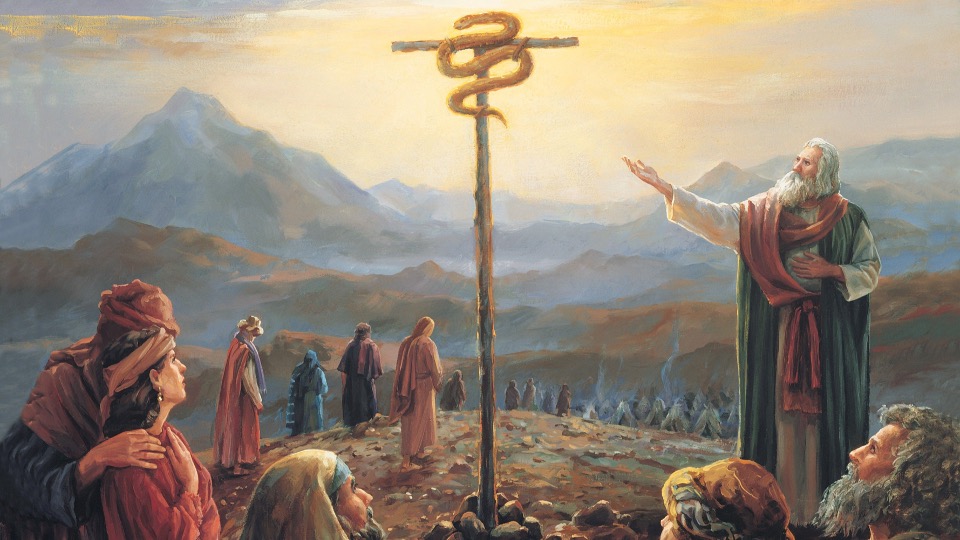
In using the image of Moses and the brazen serpent when the camp of Israel was infested by snakes and Moses held up this brazen serpent did people know they were looking at a foreshadowing or ‘type’ of the Saviour? We read in Alma 33, written around 74BC:
Behold, he was spoken of by Moses; yea, and behold a type was raised up in the wilderness, that whosoever would look upon it might live. And many did look and live. But few understood the meaning of those things, and this because of the hardness of their hearts. But there were many who were so hardened that they would not look, therefore they perished. Now the reason they would not look is because they did not believe that it would heal them (19-20).
Alma shows people didn’t understand because of the hardness of their hearts. It would appear that some of the people at the time knew that this was what was being talked about, and some of them didn’t know. I think as Latter-day Saints when we read the Old Testament we think everybody understood the scriptures as we understand them today, and I don’t think they did. Many people looked to the brazen serpent, and many didn’t, but even some of those that did didn’t know that it was a type or representation of Christ.

I often use the album cover of Pink Floyd’s ‘Dark side of the moon’ when I speak about hermeneutics. This is the way we read scripture, if we use the image of a prism and there is light going into that prism and then it is refracted. It goes into lots of different colours once it’s come out the other side of that prism. We, in terms of hermeneutics, are that prism so in we are looking at the scriptures based on our gender our background, where we live who’s taught us our religion, all of those different kinds of things. When we read the scriptures, we are interpreting them based on our own experiences. In reading the scriptures as members of the Church of Jesus Christ of Latter-day Saints it is different compared to the way that an Anglican would read them. A friend visited with me recently and said: “James I’ve got a couple of questions because I’m having a discussion with one of my colleagues about the Trinity and are there any scriptures that show that God the Father, Jesus Christ the Son, and the Holy Spirit are separate?” My response indicated that there were, for example, Jesus’ baptism where they are distinctly separate, or the prayer in the Garden of Gethsemane and the Saviour is praying to his Father. He thought these were great. I then felt the need to warn him that he was going to share those passages with his friend who would understand them through his own lens which included his would say suggest that these passages actually show the Trinity itself, and they can be explained in a different way to the way we understand them. My friend was very perturbed, essentially saying : “So basically I’m not going to be able to prove it.” Essentially, no but having said that, if we share the Joseph Smith story and the First Vision then there’s no ambiguity. The friend might say, “well that’s your story.” Yes it is, but that’s the lens through which I read the Bible and the way that I understand the Father, Son and Holy Spirit as distinct. We have to recognize that everyone approaches scripture with their own hermeneutic lens.
We understand scripture in a different way to other people and that’s really important for us to understand. Even within our own faith, based on our backgrounds and experiences, we might understand scripture or take different things in contrast to others. That’s not wrong, we just recognise that there are different interpretations. I alluded to the conversation with my friend who suggested that the book of Job is literally true in every fact; that’s fine. I may be wrong, but I am approaching it in a way that is based on my studies that lead me in different ways. It is even true within ourselves, the Greek philosopher Heraclitus is reported to have said that “You can’t step in the same river twice.” Every time we read the same scripture it is possible that we can learn something new or see something different. This isn’t because the scripture has changed, but because we have, in terms of our circumstances, questions and experiences.
Having said that, I think it is important to note that not all interpretations of scripture are correct. An interpretation of loving our neighbour to justify adultery would patently be wrong. This is out of step with the rest of scripture and the words of the prophets. Similarly, there are non-negotiables for me in understanding scripture- for example, Jesus Christ is the Saviour, the Son of God and that the First Vision did in reality happen. These provide the basis for my understandings and should not move.
Returning to finding Jesus Christ in the Old Testament we go, after his death, on the third day to the Road to Emmaus where he met two of his disciples, two of his followers. Those followers were Jews who understood the writings that would become the Old Testament. Because of their understanding of the scriptures they were devastated because the person that they thought that was the Messiah had died. These are people who have the same similar scriptures to the ones that we read today that testify of Christ and we understand what was going to happen to him, but those disciples didn’t know that. On the road to Emmaus the Saviour said to them
Then he said unto them, O fools, and slow of heart to believe all that the prophets have spoken: Ought not Christ to have suffered these things, and to enter into his glory? And beginning at Moses and all the prophets, he expounded unto them in all the scriptures the things concerning himself. And they drew nigh unto the village, whither they went: and he made as though he would have gone further. But they constrained him, saying, Abide with us: for it is toward evening, and the day is far spent. And he went in to tarry with them. And it came to pass, as he sat at meat with them, he took bread, and blessed it, and brake, and gave to them. And their eyes were opened, and they knew him; and he vanished out of their sight. And they said one to another, Did not our heart burn within us, while he talked with us by the way, and while he opened to us the scriptures? (Luke 24:25-32).
Essentially the Saviour says “look these are the scriptures you need to read them and understand that the Messiah was going to come, and was going to die and would be resurrected the third day.”
The Apostle Paul had a related experience. He described that he was a very orthodox Jew, not in the same sense that we have Orthodox Jews today but, he was very orthodox in the sense that he knew all the law he practised all of the law. As a Pharisee he had learned it his whole life. We read some of Paul’s writings and he says:
As it is written, Behold, I lay in Sion a stumblingstone and rock of offence: and whosoever believeth on him shall not be ashamed (Romans 9:33).
In Romans 1 he says something similar:
For I am not ashamed of the gospel of Christ (16).
Why should Paul be ashamed? It could be argued that he actually was at the beginning of his journey of discipleship, and this is because although he knew all of the scriptures that had been given, the idea of a crucified Messiah was a new one and he had to go back through all of the scriptures and understand how Christ was found in all of those things. Later we know that he had seen Jesus as the Christ in the scriptures:
But their minds were blinded: for until this day remaineth the same veil untaken away in the reading of the old testament; which veil is done away in Christ (2 Corinthians 3:14).
Who, being in the form of God, thought it not robbery to be equal with God: But made himself of no reputation, and took upon him the form of a servant, and was made in the likeness of men: And being found in fashion as a man, he humbled himself, and became obedient unto death, even the death of the cross. Wherefore God also hath highly exalted him, and given him a name which is above every name: That at the name of Jesus every knee should bow, of things in heaven, and things in earth, and things under the earth; And that every tongue should confess that Jesus Christ is Lord, to the glory of God the Father (Phillipians 2:6-11)
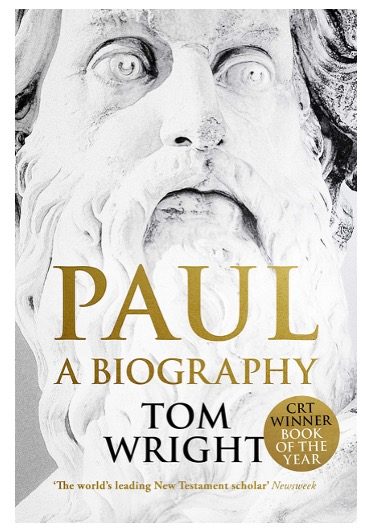
Tom Wright is one of the foremost authorities on Paul and he suggests:
He thought his way backward from the “new fact,” as he saw it, of a crucified and risen Messiah, back into the world of Israel’s scriptures and traditions, back into the long, dark, and often twisted narrative of Israel that had been groping its way forward to that point without glimpsing its true goal. He reread Genesis. He reread Exodus. He reread the whole Torah, and the prophets, especially Isaiah, and he went on praying the Psalms. With hindsight (and, he would have insisted, with a fresh wisdom that came with the spirit), he saw Jesus all over the place—not arbitrarily, not in fanciful allegory (the only time he says he’s using allegory, he is probably teasing those for whom that was a method of first resort), but as the infinite point where the parallel lines of Israel’s long narrative would eventually meet. (Wright, Tom; Paul: A Biography SPCK. p. 72)
Paul looked at the scriptures and worked his way back, and he knew this new piece of information about Jesus Christ as the Messiah, to understand the true meaning of the scripture. And that’s what we’re supposed to be doing if we can move on to the next one and these are I think three key principles that for us as members of the church of Jesus Christ we need to be concerned with:
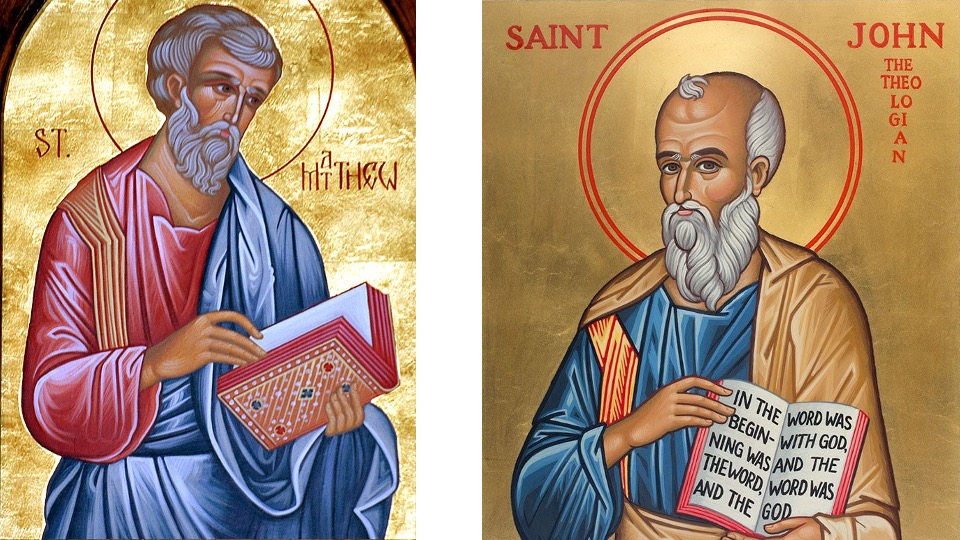
- We, like Paul, Matthew and John, are reading the Old Testament through the lens of a belief in Jesus Christ as the Messiah, the Son of God. We recognise that all things point to Him and help us understand who He is, and our relationship to Him.
- We use the New Testament, The Book of Mormon, The Doctrine and Covenants, and Pearl of Great Price to help with this interpretation.
- We are not, primarily, understanding the text as it was understood by those who first received it, or those at the time of the Saviour in what is called Second Temple Judaism (though that might be helpful and interesting). We are generally understanding it as a text that helps us today.[1]
- The questions we should ask as we study are: ‘What does this teach me about Christ?’ and ’How does this draw me closer to the Saviour?’
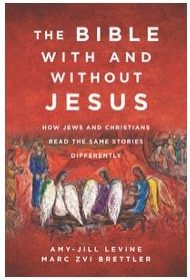
I have a book on my shelves entitled ‘The Bible with and without Jesus.’ It’s a conversation between a Jewish scholar and a Christian scholar, and they discuss the meanings of different passages, it’s very interesting and explores what the passages may have meant to people at the time. That is very important, ad will help us understand more about the Bible and its message. However, the most important way that we are to understand the text today is to understand wat it teaches me today, and tools such as this book that explores its ‘original’ meaning help us do this, but the questions we should ask are those indicated above: ‘What does this teach me about Christ?’ and ’How does this draw me closer to the Saviour?
There are some very obvious places where, as members of Church, we can see specific references to Jesus Christ. We read in Isaiah:
Therefore the Lord himself shall give you a sign; Behold, a virgin shall conceive, and bear a son, and shall call his name Immanuel.
Emmanuel meaning ‘God with us’ is very clearly a reference to Christ. Matthew’s Gospel makes this specific link, but it’s also true that many Jews before the time of Jesus didn’t necessarily apply that to the Messiah. As we study the Old Testament that doesn’t matter in many ways because we know, through the lens of a belief in Jesus as the Messiah, we know that this prophecy refers to Mary and also to her son Jesus.
In Isaiah 53 we read of the Suffering Servant:
For he shall grow up before him as a tender plant, and as a root out of a dry ground: he hath no form nor comeliness; and when we shall see him, there is no beauty that we should desire him. He is despised and rejected of men; a man of sorrows, and acquainted with grief: and we hid as it were our faces from him; he was despised, and we esteemed him not. Surely he hath borne our griefs, and carried our sorrows: yet we did esteem him stricken, smitten of God, and afflicted. But he was wounded for our transgressions, he was bruised for our iniquities: the chastisement of our peace was upon him; and with his stripes we are healed. All we like sheep have gone astray; we have turned every one to his own way; and the Lord hath laid on him the iniquity of us all. He was oppressed, and he was afflicted, yet he opened not his mouth: he is brought as a lamb to the slaughter, and as a sheep before her shearers is dumb, so he openeth not his mouth. He was taken from prison and from judgment: and who shall declare his generation? for he was cut off out of the land of the living: for the transgression of my people was he stricken. And he made his grave with the wicked, and with the rich in his death; because he had done no violence, neither was any deceit in his mouth. 10 Yet it pleased the Lord to bruise him; he hath put him to grief: when thou shalt make his soul an offering for sin, he shall see his seed, he shall prolong his days, and the pleasure of the Lord shall prosper in his hand (2-10).
For most of the Jews prior to, and at the time, of Jesus that’s not the Messiah they expected. They expected a great king. Jesus seemingly overturned this expectation. This prophecy wouldn’t have necessarily been understood or focused on as a testimony of the Saviour, but again it is central to our faith today we know that the suffering servant is all about Him.
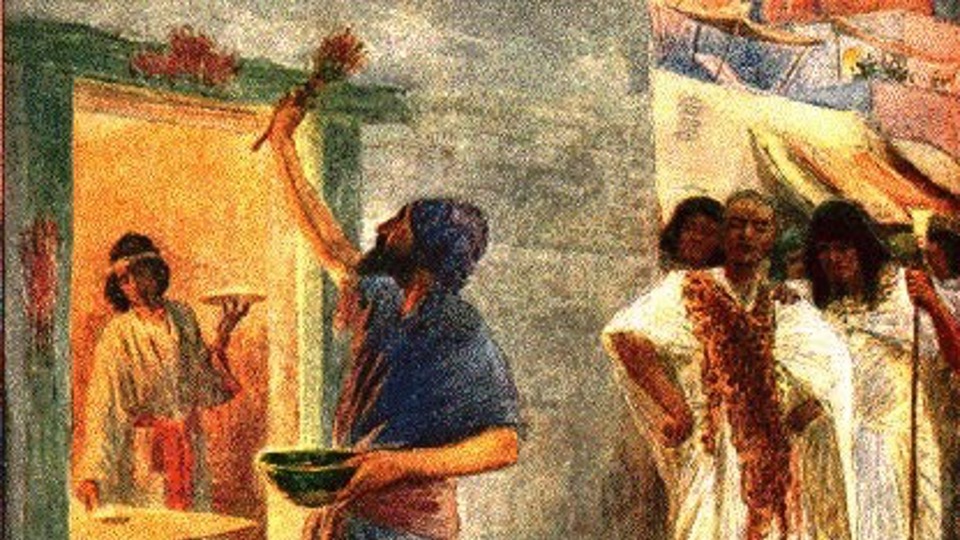
There are stories within the Old Testament similarly point us to the Saviour. There is only space to skip through a couple of examples. We read in Exodus 12 that the Passover lamb is killed, and the doorpost is painted with his blood so that the angel of death passes over. The imagery there refers to the Saviour who is the Passover lamb, the lamb without blemish.
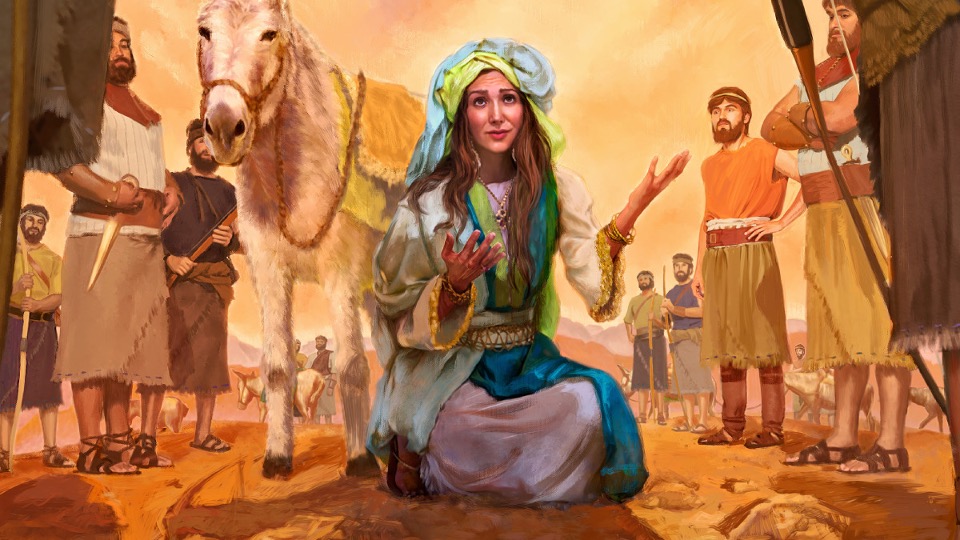
Some of the stories are not as obvious at first glance. For example, in 1 Samuel 25 we read about Abigail. I am indebted to James Farrell’s book ‘The Hidden Christ’ for this insight into Abigail as a type for Christ. Abigail is married to a man called Nabal who receives protection from King David. David sends a message to Nabal essentially saying, “we’ve been looking after you, we’ve been protecting you and we need some provisions.” In response to this seemingly reasonable request Nabal was extremely rude and refused to assist.David was very angry at Nabal’s response:
And David said unto his men, Gird ye on every man his sword. And they girded on every man his sword; and David also girded on his sword: and there went up after David about four hundred men; and two hundred abode by the stuff (1 Samuel 25:13).
Abigail heard all that had happened and response took her servants and provisions and met David begging forgiveness because she had not heard that this had happened:
Let not my lord, I pray thee, regard this man of Belial, even Nabal: for as his name is, so is he; Nabal is his name, and folly is with him: but I thine handmaid saw not the young men of my lord, whom thou didst send…I pray thee, forgive the trespass of thine handmaid: for the Lord will certainly make my lord a sure house; because my lord fighteth the battles of the Lord, and evil hath not been found in thee all thy days (1 Samuel 25:23-25, 28).
She prostrates herself before David and says, essentially, “This is my sin, I have given you all of these things but punish me instead of Nabal and his men.” Two things happen in response. Nabal’s ‘sin’ is forgiven as Abigail had taken the sin upon herself and then the wrath or the anger that David feels is turned aside. Abigail’s might be a story that is skipped over and isn’t talked about a lot, but she is a type or a foreshadowing of Christ. She took upon herself a sin that was not hers, she was guiltless. In so doing she not only forgave the sinner, or the sinner was forgiven, but ,also the anger was taken away from David’s heart. We read in in section 64 of the Doctrine Covenants that if we don’t forgive the greater sin remains in us. Abigail is one of my heroes in the way that she exemplifies and teaches of Christ.
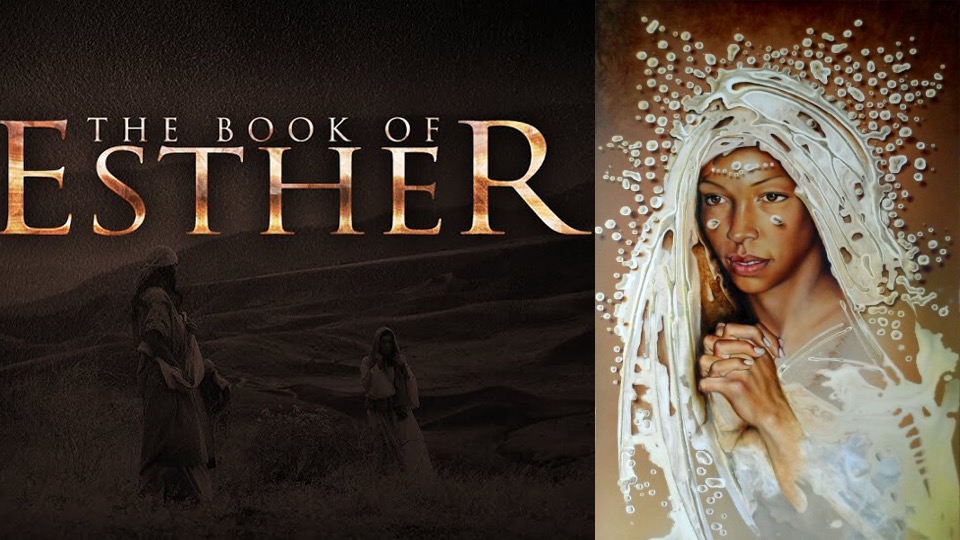
The final example I will use is Esther. Again, Esther is amazing. She is Jewish and she has married a king. The King has a scheming counsellor called Haman who hates Jews and the people of Israel. He convinces the king to make a rule that says that if you are Jewish you will be put to death. Esther is visited by her uncle, Mordecai. We know that the king loved Esther above all the women, but we read that she is reticent to intervene because she knew that there was a possibility she would be put to death. Mordecai responds to her reticence:
Think not with thyself that thou shalt escape in the king’s house, more than all the Jews. For if thou altogether holdest thy peace at this time, then shall there enlargement and deliverance arise to the Jews from another place; but thou and thy father’s house shall be destroyed: and who knoweth whether thou art come to the kingdom for such a time as this? (Esther 4:13-14).
“Who knoweth whether thou art come to the kingdom for such a time as this” is an important scripture for us all to remember. In reflecting on the two questions I posed: “What does this teach us about Christ?” and “What does this teach us about our relationship to Him?” Esther was chosen for this particular time and place, we might call that foreordination. In a similar way we have been called to a specific time and place for a specific work. Carrying on with the story we see that Esther spoke up; she went to her husband the king, risking her own life to free Israel. Israel was captive, Israel was going to die, Israel was going to be punished. Esther’s words freed them. There are things that aren’t the same as Christ, but we can see within her actions that there are things that point towards Him.
As we read the Old Testament we have all of these examples that will help us understand Christ. Sometimes we can easily skip over them because we’re looking for other things. We must remember to ask questions as we study: “What does it teach about Christ and what does it teach us about our relationship to Him?”
[1] I think I need to note here that this point refers to when exploring the scriptures from a faith perspective. I suggest that when teaching Judaism that viewing Jewish beliefs and practices through a Christian lens is wrong. I have written elsewhere:
One other consideration when teaching Judaism is that while the understanding that each of the historical periods is contiguous with the others and an understanding of Jewish history is central to understanding Judaism today, there is an associated danger. It would be erroneous to teach historical Judaism as the way that Judaism is lived today. While that may seem an obvious point to make, it should be noted that one of the concerns in teaching Judaism in schools is the temptation for teachers to teach it through a Christian lens, which in terms of history manifests itself in the teaching of a Second Temple Judaism. Judaism has come a long way, not least 2000 years since Second Temple Judaism and it would be wrong to assume the nature of the religion and of Jewish identity has stayed the same. At various points throughout this book certain elements will be highlighted that illustrate this point. For example, in the teaching about the messiah (see Chapter 3) the ‘shared’ beliefs of Judaism and Christianity are not really shared at all. The teacher who tries to teach Judaism to help understand Christianity is doing the lived reality of Judaism a disservice. The problem is that for many teachers in the UK their first encounter with Judaism is through its shared stories, which are often taught within a Christian context. The teacher of Judaism must be clear that Judaism is the religion of Jews, and everything that is believed and practised is done so on their own terms (Understanding Judaism, 2026, 13).
 jamesdholt.com
One thought on “Finding Christ in the Old Testament”