The Fall of Adam and Eve. Genesis 3–4; Moses 4–5
We continue this week with elements that unequivocably point to us to Jesus Christ and His role as Saviour and Redeemer. Without the Fall there would have been no need for a Saviour, no need for the atonement to be wrought. But there was, and there is. We realise that we say with the Apostle Paul:
For since by man came death, by man came also the resurrection of the dead. For as in Adam all die, even so in Christ shall all be made alive (1 Corinthians 15:21-22).
Similarly, Moroni:
Behold, he created Adam, and by Adam came the fall of man. And because of the fall of man came Jesus Christ, even the Father and the Son; and because of Jesus Christ came the redemption of man (Moroni 9:12).
On my mission I came across a talk that really helped me crystallise the importance of the Fall: The Three Pillars of Eternity by Elder Bruce R. McConkie. He talks about Creation, the Fall and the Atonement. He begins:
The three pillars of eternity, the three events, preeminent and transcendent above all others, are the creation, the fall, and the atonement. These three are the foundations upon which all things rest. Without any one of them all things would lose their purpose and meaning, and the plans and designs of Deity would come to naught.
If there had been no creation, we would not be, neither the earth, nor any form of life upon its face. All things, all the primal elements, would be without form and void. God would have no spirit children; there would be no mortal probation; and none of us would be on the way to immortality and eternal life.
If there had been no fall of man, there would not be a mortal probation. Mortal man would not be, nor would there be animals or fowls or fishes or life of any sort upon the earth. And, we repeat, none of us would be on the way to immortality and eternal life.
If there had been no atonement of Christ, all things would be lost. The purposes of creation would vanish away. Lucifer would triumph over men and become the captain of their souls. And, we say it again, none of us would be on the way to immortality and eternal life.
He highlights the interrelatedness of the Fall and the Atonement of Jesus Christ:
The fall of Adam and the atonement of Christ are linked together—inseparably, everlastingly, never to be parted. They are as much a part of the same body as are the head and the heart, and each plays its part in the eternal scheme of things.
The fall of Adam brought temporal and spiritual death into the world, and the atonement of Christ ransomed men from these two deaths by bringing to pass the immortality and eternal life of man. This makes the fall as essential a part of the plan of salvation as the very atonement itself.
This is where I get really nerdy. In Tolkien’s Silmarillion, there is the story of creation, and as part of that there are musical themes that are utilised and are the source of creation. A Satanic figure, Melkor, tries to thwart the melody by introducing discordant themes. However, Iluvatar (God) took these themes and used them as part of his creation and to serve his purpose. I’ve thought about this a lot over the years.
When Adam and Eve were in the Garden of Eden Satan sought to destroy the plan of salvation by tempting them: “And Satan put it into the heart of the serpent, (for he had drawn away many after him,) and he sought also to beguile Eve, for he knew not the mind of God, wherefore he sought to destroy the world” (Moses 4: 6). The important part of this scripture in this discussion is that “he knew not the mind of God”. Satan did not know that by tempting Even he was enabling the plan of the Father to come to fruition. Had Satan really wanted to disrupt the plan all he needed to do was nothing, to leave Adam and Eve in a state of innocence in the Garden. He did not do this and so his supposed disruption to the plan was taken and made glorious. This can be seen in Eve’s response to the choices she made in the Garden:
And Eve, his wife, heard all these things and was glad, saying: Were it not for our transgression we never should have had seed, and never should have known good and evil, and the joy of our redemption, and the eternal life which God giveth unto all the obedient (Moses 5: 11).
God took of what Satan thought were discordant themes and made them more wonderful than before. There is a difference between The Silmarillion and the Gospel in the sense that the discordant themes were introduced after creation, though they have their beginnings in the Council and War in Heaven.
Once a graduate student came to my office for guidance with an essay he was writing. He had decided to explore a particular aspect of Latter-day Saint belief and suggest how that tied into Pentecostal Christian theology. His premise was that as a “Restoration” movement/ Church there has to be a way to account for the fact that God has failed. The failure being the Fall. I explained to this well-meaning young man that he had missed the entire point of Latter-day Saint theology: God has not failed; humanity has and the Fall was a part of the plan from the beginning. The Lord has taken of the “discordant themes” and made them even more glorious as they serve his ends.
The Fall, as a part of the plan of salvation, is integral. Without it we could not progress to become like God. In many ways, the essential nature of it is highlighted in the parable of the Prodigal Son. When humanity was first created- as represented in the persons of Adam and Eve- they were created in a relationship with the Father- they walked and talked with him.
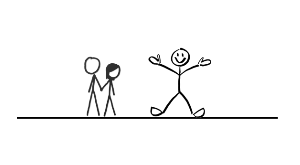
This state was indeed paradisiacal. Man knew his God and walked and talked with him. Adam was, as Joseph Smith taught, “lord or governor of all things on earth …. at the same time enjoying communication and intercourse with his Maker, without a vail to separate between” (Millet, Robert L.. The Man Adam . Deseret Book Company).
In some ways, as being the story of Adam, and by extension all of humanity, it is also the story of us as individuals. In the pre-mortal existence we were with our Heavenly Father and Jesus Christ, and were able to see and take counsel from them. We were, as were Adam and Eve, in an intimate personal relationship with God.
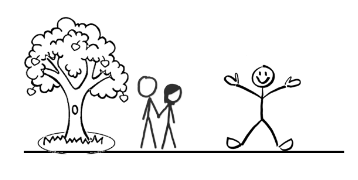
Adam and Eve’s (and by extension all of humanity’s) relationship with God is broken because of their transgression.
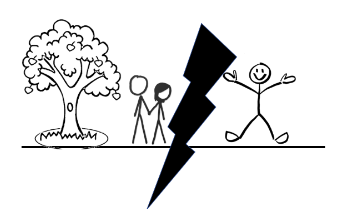
For us, because of our birth and Adam and Eve’s choice that made that possible, we have a huge chasm in our relationship with God.
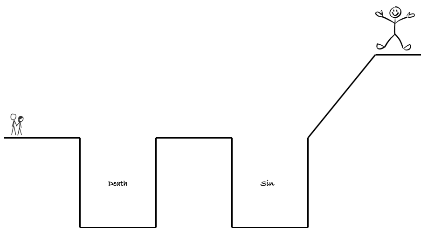
The whole purpose of this life is for us to be reconciled with God. Reconciliation is not a theological term that we hear very often in the Church, but it is the concept that lies at the heart of the message of the restored Gospel of Jesus Christ. Just as in the Parable of the Prodigal Son we have the Father who is always hoping for reconciliation.
In distinction to the parable, however, the Lord places the means to overcome this split, to be reconciled with him in front of us:
For God so loved the world, that he gave his only begotten Son, that whosoever believeth in him should not perish, but have everlasting life (John 3:16).
Do you have a testimony of the atonement of Christ and of his role as Saviour and Redeemer?
The whole purpose of Christ’s life, ministry, death and resurrection is to reconcile each of us with God today and in eternity. One of the changes to the Temple recommend questions highlights this to me. In the past it was:
This is now:
Do you have a testimony of the atonement of Christ and of his role as your Saviour and Redeemer? (emphasis added)
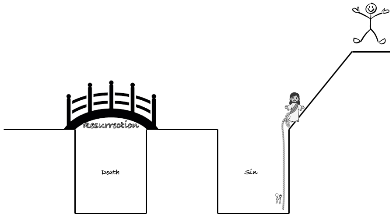
As we recognise the two aspects of the chasm- death and sin we recognise the love that Jesus has for each of us.
First of all, death:
And if Christ be not raised, your faith is vain; ye are yet in your sins. Then they also which are fallen asleep in Christ are perished. If in this life only we have hope in Christ, we are of all men most miserable. But now is Christ risen from the dead, and become the firstfruits of them that slept. For since by man came death, by man came also the resurrection of the dead. For as in Adam all die, even so in Christ shall all be made alive (1 Corinthians 15:17-22).
This resurrection, the overcoming of death that separates us from God is freely given to each person who lives on this earth:
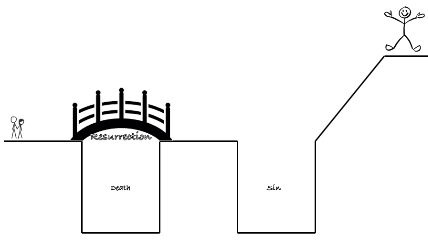
Now, there is a death which is called a temporal death; and the death of Christ shall loose the bands of this temporal death, that all shall be raised from this temporal death. The spirit and the body shall be reunited again in its perfect form; both limb and joint shall be restored to its proper frame, even as we now are at this time; and we shall be brought to stand before God, knowing even as we know now, and have a bright recollection of all our guilt. Now, this restoration shall come to all, both old and young, both bond and free, both male and female, both the wicked and the righteous; and even there shall not so much as a hair of their heads be lost; but every thing shall be restored to its perfect frame, as it is now, or in the body, and shall be brought and be arraigned before the bar of Christ the Son, and God the Father, and the Holy Spirit, which is one Eternal God, to be judged according to their works, whether they be good or whether they be evil (Alma 11:42-43).
This resurrection will be to exaltation or to salvation in one of the three kingdoms of glory in all but a few cases.
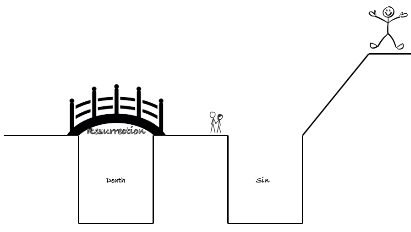
While it guarantees that we will be brought into God’s presence, it is the second chasm that determines whether reconciliation will be eternal.
The second obstacle, or pit, is that of sin. In distinction to the gift of the resurrection, we all fall into this pit and become dirty.
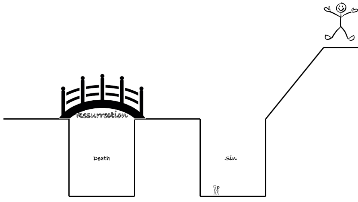
This is the part of the parable where the prodigal son is involved in debauchery, or more correctly ‘riotous living’. There comes a point where we reach recognise our situation. Sometimes it takes someone else to point it out to us, but we find ourselves filthy in a pit from which there is seemingly no escape- or no hope for reconciliation. It is then that we remember the Father and the relationship that was once ours, and could be ours again.
If I extend the analogy of the pit- the only way out, that we don’t see because of the darkness, is a rope that through the grace of Jesus Christ has been lowered for us.
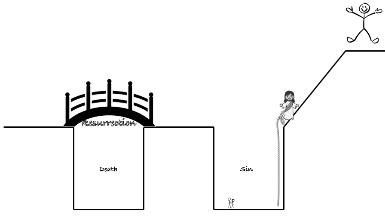
Our first act of faith is to reach out and to grab the rope and begin our relationship with Christ.
Alma describes this process in his life:
But I was racked with eternal torment, for my soul was harrowed up to the greatest degree and racked with all my sins. Yea, I did remember all my sins and iniquities, for which I was tormented with the pains of hell; yea, I saw that I had rebelled against my God, and that I had not kept his holy commandments. Yea, and I had murdered many of his children, or rather led them away unto destruction; yea, and in fine so great had been my iniquities, that the very thought of coming into the presence of my God did rack my soul with inexpressible horror. Oh, thought I, that I could be banished and become extinct both soul and body, that I might not be brought to stand in the presence of my God, to be judged of my deeds. And now, for three days and for three nights was I racked, even with the pains of a damned soul. And it came to pass that as I was thus racked with torment, while I was harrowed up by the memory of my many sins, behold, I remembered also to have heard my father prophesy unto the people concerning the coming of one Jesus Christ, a Son of God, to atone for the sins of the world. Now, as my mind caught hold upon this thought, I cried within my heart: O Jesus, thou Son of God, have mercy on me, who am in the gall of bitterness, and am encircled about by the everlasting chains of death. And now, behold, when I thought this, I could remember my pains no more; yea, I was harrowed up by the memory of my sins no more. And oh, what joy, and what marvellous light I did behold; yea, my soul was filled with joy as exceeding as was my pain! (Alma 36:12-20).
Once we have grabbed that rope, the Saviour because of his grace and his love shown through the atonement begins to pull us up. We realise what is happening and that this rescue is an expression of his love and grace. We are changed through this realisation, we become a new creature abiding in the love of our Saviour. The musician, Stormzy expresses this in his song “Blinded by your Grace”:
Lord, I’ve been broken
Although I’m not worthy
You fixed me, now I’m blinded
By your grace, you came and saved me
Lord, I’ve been broken
Although I’m not worthy
You fixed me, now I’m blinded
By your grace, you came and saved me
As an expression of our love for him we begin to climb the rope- he does not need us to but because we now recognise our relationship to, and reconciliation with, him we feel compelled to. Some people believe that while grace is a free gift from God they have to respond to that grace every day of their lives. This climbing, this living of the Gospel showing our love for him by keeping his commandments keeps us holding on to the rope and abiding in the vine. We are saved by his grace, but our continued expressions of love by following him is key:
But wilt thou know, O vain man, that faith without works is dead? Was not Abraham our father justified by works, when he had offered Isaac his son upon the altar? Seest thou how faith wrought with his works, and by works was faith made perfect? And the scripture was fulfilled which saith, Abraham believed God, and it was imputed unto him for righteousness: and he was called the Friend of God. Ye see then how that by works a man is justified, and not by faith only (James 2:20-24).
Sometimes in this imagery we imagine that since we have found the rope Christ’s work is done- it is not so- we are not left to climb the rope alone, every inch he is with us, we just need to recognise him. He is there for every muscle ache and every slip down the rope:
And he shall go forth, suffering pains and afflictions and temptations of every kind; and this that the word might be fulfilled which saith he will take upon him the pains and the sicknesses of his people. And he will take upon him death, that he may loose the bands of death which bind his people; and he will take upon him their infirmities, that his bowels may be filled with mercy, according to the flesh, that he may know according to the flesh how to succour his people according to their infirmities (Alma 7:11-12).
There may be times where we feel we are alone but invariably it is when we focus only on ourselves rather than the Saviour:
For whosoever will save his life shall lose it: and whosoever will lose his life for my sake shall find it (Matthew 16:25).
I think of times in my life where I become preoccupied with immediate issues and concerns and how they seem to be dragging me down. I get focussed on my grip on the rope or maybe a strand that seems to be becoming loose and lose sight of my Saviour and his continued love. I adopt a ‘Wo is me’ attitude and question whether I have the strength to carry on, forgetting that it is the Saviour that will enable this to happen. If we feel this way we are in good company. Joseph Smith had a similar conversation with the Lord:
O God, where art thou? And where is the pavilion that covereth thy hiding place? How long shall thy hand be stayed, and thine eye, yea thy pure eye, behold from the eternal heavens the wrongs of thy people and of thy servants, and thine ear be penetrated with their cries? Yea, O Lord, how long shall they suffer these wrongs and unlawful oppressions, before thine heart shall be softened toward them, and thy bowels be moved with compassion toward them? (D&C 121:1-3)
And if thou shouldst be cast into the pit, or into the hands of murderers, and the sentence of death passed upon thee; if thou be cast into the deep; if the billowing surge conspire against thee; if fierce winds become thine enemy; if the heavens gather blackness, and all the elements combine to hedge up the way; and above all, if the very jaws of hell shall gape open the mouth wide after thee, know thou, my son, that all these things shall give thee experience, and shall be for thy good. The Son of Man hath descended below them all. Art thou greater than he? Therefore, hold on thy way… (D&C 122:7-9)
The response is not ‘quit bellyaching, I’ve had it worse’ which is one way it could be read, but ‘Hold on! And you can hold on because I have descended below them all- I know the end from the beginning and I can give you the strength to both hold on and to understand the situation.’
The beginning of this reconciled relationship is now. One day we will be found in our Father’s eternal mansions but today we live in a renewed relationship with the Father and the Son.

This is important as we may consider the natural man that may be seen as a result of the Fall. Bruce R. McConkie reminds us that King Benjamin:
… said, “The natural man is an enemy to God, and has been from the fall of Adam, and will be, forever and ever, unless he yields to the enticings of the Holy Spirit, and putteth off the natural man and becometh a saint through the atonement of Christ the Lord” (Mosiah 3:19).
Thus the natural man, which is Adam, is conquered by the perfect man, which is Christ; and thus “all mankind may be saved by obedience to the laws and ordinances of the gospel” (Third Article of Faith).
This is the message of the Fall and the Atonement for us today; it is the way that we are able to put off the natural man today, and become a new creature in Christ (Mosiah 27:26; see also 2 Corinthians 5: 17; and Galatians 6:15). Reconciliation with God is fully realised through eternal life, but right now we can be reconciled to Him through Christ. This process of becoming a new creature is best illustrated in The Book of Mormon following King Benjamin’s discourse. The people who heard this last sermon went through the sanctification process; they humbled themselves and prayed the atoning blood of Christ would take effect in their lives. The Holy Ghost came upon them and filled them with joy; they experienced a change of heart and had “no more disposition to do evil, but to do good continually” (Mosiah 5:2). This isn’t a one-time event but is something that needs to be constantly developed.
And now behold, I say unto you, my brethren, if ye have experienced a change of heart, and if ye have felt to sing the song of redeeming love, I would ask, can ye feel so now? (Alma 5:26).
This continual and ongoing renewal reflects the importance of developing the lifelong relationships with Christ and the Holy Ghost. Only through their influence can a person hope to become a new creature and receive salvation. Parley P. Pratt once described the process of becoming a new creature/receiving sanctification, the Holy Ghost:
…quickens all the intellectual faculties, increases, enlarges, expands, and purifies all the natural passions and affections, and adapts them, by the gift of wisdom, to their lawful use. [He] inspires, develops, cultivates, and matures all the fine-toned sympathies, joys, tastes, kindred feelings, and affections of our nature. [He] inspires virtue, kindness, goodness, tenderness, gentleness, and charity. [He] develops beauty of person, form, and features. [He] tends to health, vigour, animation, and social feeling. [He] invigorates all the faculties of the physical and intellectual man. [He] strengthens and gives tone to the nerves. In short, [he] is, as it were, marrow to the bone, joy to the heart, light to the eyes, music to the ears, and life to the whole being (Parley P. Pratt, Key to the Science of Theology , 61).
It is not just a passive process, but one where ‘bad’ qualities are replaced with Christlike characteristics. This new birth and its continued renewal has been called many things- perhaps most recently it has been described as the covenant path. This is an important understanding and one that should not be glossed over, but as I think about the process, the phrase that sticks most in my mind is that of discipleship
In the story of the prodigal son- we are not an onlooker to what is happening, we are not the ‘good one’- we are the prodigal son. The one who through the very act of living in mortality was separated from God. We are him who very nearly shared the pig’s food- but we are also the one for whom the Father is constantly watching, ready with our robe and the party all ready to welcome us home. The reconciliation would not have been possible without the Fall.
The Fall was essential for humanity, even beyond the atonement of Christ (which would have sufficient reason in itself). We read from Lehi:
And after Adam and Eve had partaken of the forbidden fruit they were driven out of the garden of Eden, to till the earth. And they have brought forth children; yea, even the family of all the earth. And the days of the children of men were prolonged, according to the will of God, that they might repent while in the flesh; wherefore, their state became a state of probation, and their time was lengthened, according to the commandments which the Lord God gave unto the children of men. For he gave commandment that all men must repent; for he showed unto all men that they were lost, because of the transgression of their parents. And now, behold, if Adam had not transgressed he would not have fallen, but he would have remained in the garden of Eden. And all things which were created must have remained in the same state in which they were after they were created; and they must have remained forever, and had no end. And they would have had no children; wherefore they would have remained in a state of innocence, having no joy, for they knew no misery; doing no good, for they knew no sin. But behold, all things have been done in the wisdom of him who knoweth all things (2 Nephi 2:19-24 emphasis added).
Adam and Eve’s reflection later in life on the events of the Fall help us realise the impact and the blessing that is the Fall:
And in that day the Holy Ghost fell upon Adam, which beareth record of the Father and the Son, saying: I am the Only Begotten of the Father from the beginning, henceforth and forever, that as thou hast fallen thou mayest be redeemed, and all mankind, even as many as will. And in that day Adam blessed God and was filled, and began to prophesy concerning all the families of the earth, saying: Blessed be the name of God, for because of my transgression my eyes are opened, and in this life I shall have joy, and again in the flesh I shall see God. And Eve, his wife, heard all these things and was glad, saying: Were it not for our transgression we never should have had seed, and never should have known good and evil, and the joy of our redemption, and the eternal life which God giveth unto all the obedient (Moses 5:9-11).
We perhaps stand distinct within Christianity with this hopeful view of the Fall. Wider Christianity do view it positively in the sense that it links with the Atonement of Christ, but the positive choice that Eve made can perhaps stand in distinction. Joseph McConkie and Bob Millet suggest:
Too often the picture that is painted is that of Adam, bent and bowed in his new world of thorns and thistles, with the weak and gullible Eve dutifully following behind. Revealed religion exults in the Fall and rejoices in the blessings that flow from it (2 Ne. 2:25). The Adam we see is one who “blessed God and was filled…”
Although the story of Adam and Eve is the story of all of us- it is our story as we are separated from God through our choices, it is also important to note that Adam and Eve existed. In light of last week’s notes where I discussed my metaphorical understanding of the accounts of creation, this does not take away the fact that there were people called Adam and Eve, they were not figurative imaginations. McConkie and Millet highlight this:
We accept Adam and Eve as real persons who lived, transgressed, and brought about their own fall and the consequent fall of all mankind. If we had a complete record it would be possible to mark on the calendar the actual time that the Fall occurred. Likewise, if we had an adequate map it would be possible to mark the exact spot where the transgression occurred. The Fall is just that real and absolute. A real man and a real woman did, at a particular time and geographical location, transgress a commandment which brought about the fall of man, an event which has affected not only all of mankind but also the whole creation. The Fall is a historical event, an actual fact, an absolute occurrence, and is not simply a philosophical or so-called “religious” truth.
Referring to my friend Ben Spackman from last week, in his research he discovered that Gordon B. Hinckley ‘ghost wrote’ the entry on Evolution in the Encyclopedia of Mormonism:
Man is the child of God, formed in the divine image and endowed with divine attributes (see Appendix, “Doctrinal Expositions of the First Presidency”).
The scriptures tell why man was created, but they do not tell how, though the Lord has promised that he will tell that when he comes again (D&C 101:32-33). In 1931, when there was intense discussion on the issue of organic evolution, the First Presidency of the Church, then consisting of Presidents Heber J. Grant, Anthony W. Ivins, and Charles W. Nibley, addressed all of the General Authorities of the Church on the matter, and concluded, Upon the fundamental doctrines of the Church we are all agreed. Our mission is to bear the message of the restored gospel to the world. Leave geology, biology, archaeology, and anthropology, no one of which has to do with the salvation of the souls of mankind, to scientific research, while we magnify our calling in the realm of the Church;.
Upon one thing we should all be able to agree, namely, that Presidents Joseph F. Smith, John R. Winder, and Anthon H. Lund were right when they said: “Adam is the primal parent of our race” [First Presidency Minutes, Apr. 7, 1931].
What this means and how this works is not known, but we explore the writings of the First Presidency we realise it has not been revealed. They suggested three possibilities, but this is not to limit the interpretations to one of them:
Whether the mortal bodies of man evolved in natural processes to present perfection, through the direction and power of God; whether the first parents of our generations, Adam and Eve, were transplanted from another sphere, with immortal tabernacles, which became corrupted through sin and the partaking of natural foods, in the process of time; whether they were born here in mortality, as other mortals have been, are questions not fully answered in the revealed word of God (emphasis to show the three possibilities mentioned).
To reiterate, we know that Adam and Eve existed, that they are our parents and that through them the Fall occurred.
There’s lots more we could discuss in this week’s Come Follow Me, but with nearly 5,000 words I think that’s probably enough for nowJ
 jamesdholt.com