In this post I include an excerpt from Gospel Lessons from my Heroes that explores the lessons I have learned about my discipleship as I reflect on Elphaba in the book/show/film Wicked. If you haven’t seen the film yet a warning there are SPOILERS in the below.
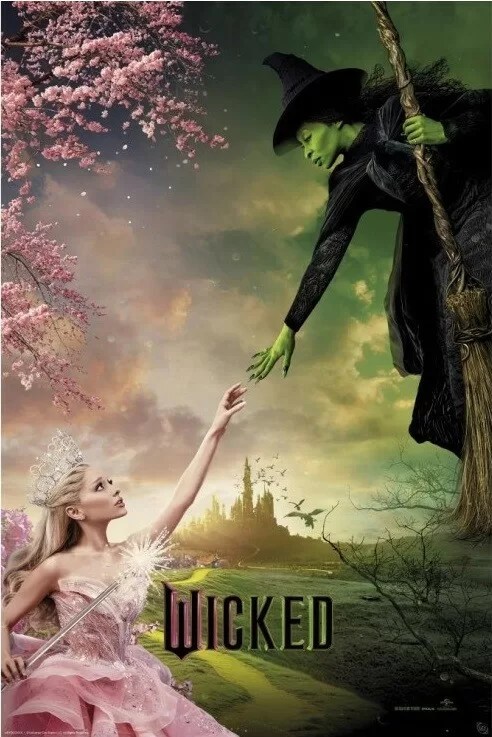
Elphaba is perhaps better known by her original description in L. Frank Baum’s The Wizard of Oz: The Wicked Witch of the West. The story of Dorothy and her companions was reimagined by Gregory Maguire, and then latterly on the stage and film in Wicked: The Life and Times of the Wicked Witch of the West. It may seem strange in a discussion that seems to focus on comic book and film characters to choose someone who is best known from musical theatre, but from her I have been inspired in different ways to live the Gospel just that little bit better, and to become more Christlike in my discipleship.
When we read or watch the original Wizard of Oz the picture that we are presented of the Wicked Witch of the West is very one dimensional, in that she is evil personified. The presentation of Elphaba in Wicked is much more nuanced. There are elements of her character and actions that are bad, but that doesn’t necessarily make her a bad person. I am reminded of the line from Wreck-it-Ralph where one person is ruminating on the complexity of his character: “You are bad guy, but this does not mean you are bad guy.” She is someone who is trying to do her best. Elphaba’s actions lead me to consider how I could better live as a disciple of Jesus Christ.
The Wizard in the original book is seen to be a fraud, but it would appear a well-meaning one who just got caught up in the moment. In Wicked, while he is the same person from our world he is also seen to be a character of a much more dangerous nature. As ruler of Oz he is seen to be an oppressive and callous leader. The most obvious example of this is in his treatment of the Animals (the A is capitalised to differentiate between the sentient Animals who are able to think and other animals who are not). In the song ‘Something bad is happening in Oz’ Elphaba talks with her history professor, Dr Dillamond, who is a Goat. They talk about reports of the oppression of Animals, with some being removed from teaching posts and others losing the ability of teach. The denial of sentience and rights to Animals is horrendous to Elphaba. She can’t countenance that such an event is happening and that the great Wizard cannot know of such a thing, and thinks someone should tell him.
There are many aspects of these and the resultant events that give me pause, and help me consider my responses to injustices and the living of the Gospel of Jesus Christ. Elphaba is not directly affected by the policies or the injustices that are being endured by Animals but she is motivated to action. Sometimes I can sit in the safety of my circumstances and pretend nothing is happening, or that the events in my community, wider society, and the world are of no concern to me because they don’t affect me. This isn’t the point, if I see social inequality or injustice, as a disciple of Jesus Christ I should respond in an Elphaba-like way. We can consider the Parable of the Sheep and Goats in Matthew 25 where the Saviour declares: “Verily I say unto you, Inasmuch as ye have done it unto one of the least of these my brethren, ye have done it unto me.” (verse 40). Perhaps verse 45 is more sobering as the Saviour declares the opposite; that if we didn’t feed the hungry or clothe the naked it is as though we ignored Him.
There are elements of this parable that find their expression in King Benjamin’s discourse in The Book of Mormon:
And also, ye yourselves will succour those that stand in need of your succour; ye will administer of your substance unto him that standeth in need; and ye will not suffer that the beggar putteth up his petition to you in vain, and turn him out to perish. Perhaps thou shalt say: The man has brought upon himself his misery; therefore I will stay my hand, and will not give unto him of my food, nor impart unto him of my substance that he may not suffer, for his punishments are just— But I say unto you, O man, whosoever doeth this the same hath great cause to repent; and except he repenteth of that which he hath done he perisheth forever, and hath no interest in the kingdom of God. For behold, are we not all beggars? (Mosiah 4:16-19).
The call to discipleship is a call to service, and far more than Elphaba-like service, but Christlike service. Christ taught us all to love our enemies, and he showed how much he loved even those who nailed him to the cross, as he died for them and prayed for their forgiveness. Joseph Smith’s teachings highlight the need for feelings of love and compassion, rather than judgement and division. On one occasion he taught us about the qualities of the Lord:
But while one portion of the human race are judging and condemning the other without mercy, the great parent of the universe looks upon the whole of the human family with a fatherly care, and paternal regard; he views them as his offspring; and without any of those contracted feelings that influence the children of men, causes “his sun to rise on the evil and the good; and sends his rain on the just and unjust.” He holds the reins of judgment in his hands; he is a wise lawgiver, and will judge all men, -[not according to the narrow contracted notions of men, but]- “according to the deeds done in the body whether they be good or evil;” or whether these deeds were done in England, America, Spain, Turkey India… and when the designs of God shall be made manifest, and the curtain of futurity be withdrawn, we shall all of us eventually have to confess, that the Judge of all the earth has done right (1842).
We should act in a similar way. As I reflect on my service and the expressions of my love I can see that it is easier to show love to those closest to me. If I think about my circles of influence, the closest circle to me is my family, then my friends, other people I know, and then people in the world who may currently be strangers. It is perhaps easier for me to show love to those closer to me, and that the Christlike love I should have is reduced as I work outward. The message of the Gospel of Jesus Christ is that just as Christ showed his love to all, we should be willing to do the same. The heart of our actions as disciples of the Saviour is contained in the Golden Rule: “Therefore all things whatsoever ye would that men should do to you, do ye even so to them” (Matthew 7:12).
The withholding of our love because of who a person is or their particular circumstance is contrary to the Gospel. We believe in a Heavenly Father who loves each of his children, and in our hearts there should be no division. Joseph Smith was once asked why people followed him as a prophet of the Lord. He replied:
…it is because I possess the principle of love, all I can offer the world is a good heart and a good hand. The Saints can testify whether I am willing to lay down my life for my brethren. If it has been demonstrated that I have been willing to die for a Mormon, I am bold to declare before heaven that I am just as ready to die in defending the rights of a Presbyterian, a Baptist or a good man of any other denomination; for the same principle which would trample upon the rights of the Latter day Saints would trample upon the rights of the other denomination <Roman Catholics> or of any other denomination who may be unpopular and too weak to defend themselves (1843-1844)
I love this passage. I spend my life learning and teaching about the religions of the world. As I do this I hope to instil in the people that I teach a respect for others and the realisation that all of our lives are interconnected. This particular teaching was brought home to me one day when I received a knock on my door. It was a couple of people from my local community asking me to sign a petition to stop the building of a Mosque in the local area. How would I have felt if people were protesting the building of a chapel? They left the doorstep without a signature and fully aware that I completely disagreed with their efforts. As members of The Church of Jesus Christ of Latter-day Saints we should be willing to stand for the truth and for human rights, even if it does not directly affect us. As part of our baptismal covenants we promise “to stand as witnesses of God at all times and in all things, and in all places that ye may be in” (Mosiah 18:9).
There is much more to the story of Elphaba, but I think the immediate consequence of her visit to the Emerald City and an audience with the Wizard helps me understand the responsibilities outlined above just a little bit more. Upon meeting with the Wizard she becomes aware that he knows everything that is going on and is actually responsible for the suppression of the Animals. Seeing her passion and power he offers Elphaba a place at his side, which has previously been her dream. While her friend, Glinda encourages her to take on this role, Elphaba realises that she can’t sacrifice what she knows to be right for her own ego, power and popularity. As a result of her rejection of the Wizard’s offer she is labelled as the ‘Wicked Witch’ by the Wizard’s regime. In an Abinadi-like fashion we must be willing to stand for truth, even if it means standing alone and maybe losing popularity and position. In the long run people will respect us for the integrity that we have in standing for truth. It might be uncomfortable for a while, but we must feel confident to stand in the presence of the Lord. Standing for truth might include standing up for the rights of others, or it might be taking a stand against immorality by walking out of a film.
 jamesdholt.com
One thought on “Lessons from Elphaba: Discipleship Through Wicked”