To Be a Greater Follower of Righteousness”
Genesis 12–17; Abraham 1–2
The focus of this week’s reading surrounds Abraham and the covenant he made with God. Come Follow Me highlights that:
Because of the covenant God made with him, Abraham has been called “the father of the faithful” (Doctrine and Covenants 138:41) and “the Friend of God” (James 2:23). Millions today honour him as their direct ancestor, and others have been adopted into his family through conversion to the gospel of Jesus Christ. Yet Abraham himself came from a troubled family—his father, who had abandoned the true worship of God, tried to have Abraham sacrificed to false gods. In spite of this, Abraham’s desire was “to be a greater follower of righteousness” (Abraham 1:2), and the account of his life shows that God honoured his desire. Abraham’s life stands as a testimony that no matter what a person’s family history has been, the future can be filled with hope.
In terms of the Abrahamic Covenant, I have explored this in Judaism- I think it serves a useful prelude to our understanding in the Restored Gospel:
With the Abrahamic Covenant the Almighty formalises a more concentrated relationship with what will become known as the House of Israel.
In many ways it is straightforward to outline the two sides of the Abrahamic Covenant according to the account in Genesis:
The LORD said to Abram, “Go forth from your native land and from your father’s house to the land that I will show you. I will make of you a great nation, And I will bless you; I will make your name great, And you shall be a blessing. I will bless those who bless you And curse him that curses you; And all the families of the earth Shall bless themselves by you” (Genesis 12:1-3).
The headlines of the Covenant of the Almighty with Abraham is that he will be a great nation and that all the world will be blessed because of Abraham and his descendants. The precise elements of the covenant are explained further in chapters 15 and 17 of Genesis. Genesis 15 begins with a vision for Abram who is worried that he is childless, and that his heir would be his servant Eliezer. In response to Abram’s concern the Almighty reassures him that Eliezer would not be his heir, and that his “very own issue shall be your heir” (Genesis 15:4). To further confirm this:
He took him outside and said, “Look toward heaven and count the stars, if you are able to count them.” And He added, “So shall your offspring be.” And because he put his trust in the LORD, He reckoned it to his merit (Genesis 15:5-6).
Abram is promised again that he will be a great nation, and that his seed would be as numerous as the stars. The Almighty changed Abram’s name to Abraham, meaning ‘father of multitudes’ because he will be made “the father of a multitude of nations” (Genesis 17:5).
As the second part of the Almighty’s Covenant explored in Genesis 15 Abraham and his descendants are promised a land:
Then He said to him, “I am the LORD who brought you out from Ur of the Chaldeans to assign this land to you as a possession.”… On that day the LORD made a covenant with Abram, saying, “To your offspring I assign this land, from the river of Egypt to the great river, the river Euphrates…” (Genesis 15:7, 18).
This ‘Promised Land’ later became known as Israel (its first use as attached to the land is found in 1 Samuel 13:19), named after Abraham’s grandson Jacob (later Israel). The exact location is described at various points in the Tanakh, not always consistently, it is identified with the land of Canaan (Genesis 17:8; Numbers 34:2); the land demarcated by the Red Sea, the Mediterranean and the Euphrates (Exodus 23), alongside other interpretations.
This covenant is confirmed with the offering of a “a three-year-old heifer, a three-year-old she-goat, a three-year-old ram, a turtledove, and a young bird” (Genesis 15:9) which Abraham brought before the Almighty and “cut them in two, placing each half opposite the other; but he did not cut up the bird” (Genesis 15:10). For this reason, the covenant is sometimes called Brit Bein HaBetarim or Covenant of the Pieces. The covenant is further confirmed by the sign or symbol of the covenant, brit milah or circumcision:
Such shall be the covenant between Me and you and your offspring to follow which you shall keep: every male among you shall be circumcised. You shall circumcise the flesh of your foreskin, and that shall be the sign of the covenant between Me and you. And throughout the generations, every male among you shall be circumcised at the age of eight days. As for the homeborn slave and the one bought from an outsider who is not of your offspring, they must be circumcised, homeborn and purchased alike. Thus shall My covenant be marked in your flesh as an everlasting pact. And if any male who is uncircumcised fails to circumcise the flesh of his foreskin, that person shall be cut off from his kin; he has broken My covenant (Genesis 17:10-14).
Thus, the terms of the covenant on the part of Abraham and his descendants are circumcision and to worship the Almighty and by implication follow his commands. Although not evident in the passages outlined above, the suggestion is that in the subsequent command to sacrifice Isaac and Abraham’s willingness to do so, results in blessings and the terms of the covenant being confirmed. The Almighty says:
Because you have done this and have not withheld your son, your favoured one, I will bestow My blessing upon you (Genesis 22:16-17).
Further confirmed in Genesis 26:
I will make your heirs as numerous as the stars of heaven, and assign to your heirs all these lands, so that all the nations of the earth shall bless themselves by your heirs— inasmuch as Abraham obeyed Me and kept My charge: My commandments, My laws, and My teachings (4-5).
This is later confirmed in the covenant at Sinai, but for many Jews is inherent in the Genesis narrative. The Prophet Jeremiah hearkens back to the confirmation of the covenant and its conditional nature when he writes:
I will make the men who violated My covenant, who did not fulfil the terms of the covenant which they made before Me, [like] the calf which they cut in two so as to pass between the halves (Jeremiah 34:18).
This covenant is important for Jews throughout history and today as it confirms the identity of the Jews as a people and more specifically the chosen people of the Lord. This concept needs greater unpicking but at this point it is important to note how Wayne Dosick (1995) explains this concept:
Throughout the centuries, detractors of Jews and Judaism have pointed to the concept of chosenness as an attempt by Jews to flaunt supposed superiority and great-ness. In reality, just the opposite is true. The concept of chosen people means not that Jews were chosen for special privilege, but for sacred responsibility: to be … a “light unto the nations” (after Isaiah 42:6, 496), a faith community reflecting God’s light of love and law. The sacred Jewish responsibility is to receive, learn, live, and teach God’s word and will. Receiving and transmitting the “yoke of the Kingdom of God” is no easy tasks it is a heavy burden, but one that is willingly and even joyously, but always humbly, accepted (19).
Echoed by two Jews living in Britian today:
[The covenant] highlights the expectation that we are subject to a higher ethical standard, being a light to the nations.
I think we have a sense of righteousness and justice and always trying to do the right thing.
The Abrahamic Covenant establishes for Jews an important aspect of their relationship with the Divine. Weinfeld (1970) argues that the covenant is an example of a suzerain-vassal treaty being “an obligation of the vassal to his master, the suzerain, the ‘grant’ constitutes an obligation of the master to his servant” (185). The covenant is therefore “a reward for loyalty and good deeds already performed” and “an inducement for future loyalty” (Weinfeld, 1970, 185). This establishes, in light of Chapter 1 and the discussion of the characteristics of the Almighty, the belief in his omnipotence and the complete dependence of humanity on the Almighty. This is developed further in the Covenant at Sinai.
In understanding covenants, we know that in the Abrahamic covenant there are two parts- in Hebrew the words are brit and chesed. Exploring the meaning of ‘brit’ it suggests the conditional part of the covenant- if you do this, then… Whereas chesed is that aspect of the covenant that shows love. In essence if we give too much emphasis to one rather than the other then our understanding of the Lord becomes skewed. If we focus solely on brit, the Lord becomes a lawgiver who is focussed on us only as far as we are obedient. Whereas if we focus on chesed, he excuses any of our sins or transgressions, and we know from the Book of Mormon, that if he were to do that, he would cease to be God. So, there is a balance, and we recognise that we must make covenants, and that at every stage the Lord loves us whether we fall short or not. This, then helps us realise that as we keep covenants, they must be more than a compliance check, they are expressions of his love. As we know, our journey on the covenant path is about becoming, and therefore the covenants help us become more than we can be without them.
We know that as members of the Church we become part of Israel, we are the seed of Abraham. When I first joined the Church, I remember being told that we were adopted into the family of Abraham. Over the years I learned that while some are adopted into Abraham’s family at baptism, a large number are literally of his seed, and it does not matter either way- whether by adoption or by blood as members of the Church we are children of the covenant and heirs to all of its promises, blessings and responsibilities.
Most of those designated as Gentiles in the Book of Mormon are, indeed, members of the house of Israel by lineal descent. Many of them, however, have not entered into the covenant, for they have not taken upon them the name of the Mediator of that covenant and entered into the covenant gospel through an authorised baptism in his name… Through the glad tidings of the Restoration-and specifically through the message to Israel contained in the Book of Mormon-descendants of Jacob discover who they are and come to know, once again, the voice of their Shepherd (McConkie and Millet).
I always find it interesting when listening to the sealing of a child to their parents; it contains words along the lines of ‘as though you were born in the covenant.’ There is no distinction made once the ordinance takes place. This is just so with the ordinance of baptism, the initial symbol of being gathered.
The Abrahamic Covenant is woven into the fabric of Nephi’s vision, it is the backdrop against which everything else makes sense. In this way, the Gentiles become aware of and part of the covenant, which in many ways has been lost as part of the loss of the plain and precious things.
Indeed, I teach regularly about the covenant with Abraham in my religion classes at university. We trace the lineage of the family of Abraham- how Jews descend from the line of Isaac, while Muslims through the line of Ishmael- indeed, Prophet Muhammad was a descendant of Ishmael. This continues to have an impact today in the contested nature of Canaan, the Holy Land. When students ask about Chirstian views, my flippant but incomplete answer is that most Christians don’t worry about it as the Covenant is believed to have been fulfilled in the person of Jesus. As members of the Church, we know differently- we know that the Abrahamic Covenant is eternal and in place. Thus, with the restoration of this knowledge the destiny of the ‘house of Israel shall no more be confounded.’ Similarly, this confounding is stopped as Israel is gathered.
Every person who enters the waters of baptism and receives the Priesthood becomes the seed of Abraham. A part of that Abrahamic Covenant- so that we can become heirs of Abraham to Celestial Glory and all that the Father hath- is to “responsibly carry the gospel to all the peoples if the earth. Abraham’s seed have carried out the missionary activity in all the nations since Abraham’s day” (Matt 3:9, Abr 2:9-11)” (Bible Dictionary Abraham, Covenant of). While the house of Israel may have strayed, then they are remembered of the Lord, and they will be reminded of the covenant and their role in the blessing of all of the peoples of the earth. Gordon B. Hinckley taught how people will be reminded and gathered:
The covenant between Jehovah and Abraham … that through him and his seed all nations of the earth might be blessed and that Jehovah would be their God and they would be His people… And one of the purposes of the Restoration of this gospel is that this covenant might be reaffirmed in this, the dispensation of the fullness of times. … The everlasting covenant, between Jehovah and Abraham, … extends to all of his posterity and beneficiaries, whether they be by literal descent or whether they might come into that great family by adoption… Every baptism that you perform places someone under covenant—again this eternal and everlasting covenant, a special relationship with God, our Eternal Father, and the risen Lord Jesus Christ. Every time we partake of the sacrament, we renew that covenant. … He in turn says that His Spirit will be with us. That is a covenant, a two-party contract. … As all of you know who have been to a temple, we take upon ourselves covenants and obligations regarding lives of purity and virtue and goodness and truth and unselfishness to others (Discourses of President Gordon B. Hinckley, 408-409).
This is heartening to know that the Lord will always remember His covenants with His people. It also promises us, as Latter-day Israel, that we will bless the nations of the earth as we share His Gospel and gather Israel from among all nations.
As members of the Church, we often speak about the Abrahamic Covenant, but I wonder if I forget how central it is to salvation history and to the plan of salvation? Elder Russell M. Nelson speaks of the scattering and the gathering of Israel:
God’s promise for the gathering of scattered Israel was equally emphatic. Isaiah, for example, foresaw that in the latter days the Lord would send “swift messengers” to these people who were so “scattered and peeled.”
This promise of the gathering, woven all through the fabric of the scriptures, will be fulfilled just as surely as were the prophecies of the scattering of Israel.
As we study the scriptures, as well as focussing on learning about the Saviour, recognising that the Abrahamic Covenant and its attendant gathering is woven through its fabric, we can also begin to ask ourselves what we are leaning about the gathering of Israel throughout history, but in particular in the Latter-days.
One thing of note is that the Apostle Paul offers a seemingly different interpretation of the blessing of all nations through the seed of Abraham. He suggests that the seed through which the nations of the world will be blessed is the Saviour:
Brethren, I speak after the manner of men; Though it be but a man’s covenant, yet if it be confirmed, no man disannulleth, or addeth thereto. Now to Abraham and his seed were the promises made. He saith not, And to seeds, as of many; but as of one, And to thy seed, which is Christ. And this I say, that the covenant, that was confirmed before of God in Christ, the law, which was four hundred and thirty years after, cannot disannul, that it should make the promise of none effect. For if the inheritance be of the law, it is no more of promise: but God gave it to Abraham by promise. Wherefore then serveth the law? It was added because of transgressions, till the seed should come to whom the promise was made; and it was ordained by angels in the hand of a mediator (Galatians 3:15-19).
A couple of observations here. Later in this chapter Paul suggests:
And if ye be Christ’s, then are ye Abraham’s seed, and heirs according to the promise (3:29).
By accepting Christ, we become His seed and He becomes our Father. We also become Abraham’s seed as we accept His Gospel. Isaiah 53:10 gives us an insight into this:
Yet it pleased the Lord to bruise him; he hath put him to grief: when thou shalt make his soul an offering for sin, he shall see his seed, he shall prolong his days, and the pleasure of the Lord shall prosper in his hand (Isaiah 53:10).
Commenting on this verse, Elder Merril J. Bateman explained:
In the garden and on the cross, Jesus saw each of us [therefore] the Saviour’s atonement in the garden and on the cross is intimate as well as infinite. Infinite in that it spans the eternities. Intimate in that the Saviour felt each person’s pains, sufferings, and sicknesses.
Thus, Paul and Nephi’s interpretations can stand together. It also works because it is possible for prophecy to be fulfilled at two different times. The promise of Abraham’s seed is fulfilled through Christ and through His people in the latter-days.
Terah, the father of Abraham
The biblical record tells us not a lot about Terah. What we learn is:
- He was the ninth in descent from Noah through Shem. Further:
And Terah lived seventy years, and begat Abram, Nahor, and Haran. Now these are the generations of Terah: Terah begat Abram, Nahor, and Haran; and Haran begat Lot (Genesis 11:26-27 see also 1 Chronicles 1:17-27 and Luke 3:34-36 for further genealogy).
- Terah moved with his family from Ur to Haran:
And Terah took Abram his son, and Lot the son of Haran his son’s son, and Sarai his daughter in law, his son Abram’s wife; and they went forth with them from Ur of the Chaldees, to go into the land of Canaan; and they came unto Haran, and dwelt there. And the days of Terah were two hundred and five years: and Terah died in Haran (Genesis 11:31-32).
- The suggestion is that he ‘served other gods”:
And Joshua said unto all the people, Thus saith the Lord God of Israel, Your fathers dwelt on the other side of the flood in old time, even Terah, the father of Abraham, and the father of Nachor: and they served other gods (Joshua 24:2).
The Book of Abraham gives us more information about Terah and his ‘disobedience’ than is found in the biblical record. We learn that, not just Terah, but also all:
My fathers, having turned from their righteousness, and from the holy commandments which the Lord their God had given unto them, unto the worshiping of the gods of the heathen, utterly refused to hearken to my voice; For their hearts were set to do evil, and were wholly turned to the god of Elkenah, and the god of Libnah, and the god of Mahmackrah, and the god of Korash, and the god of Pharaoh, king of Egypt; Therefore they turned their hearts to the sacrifice of the heathen in offering up their children unto these dumb idols, and hearkened not unto my voice, but endeavoured to take away my life by the hand of the priest of Elkenah. The priest of Elkenah was also the priest of Pharaoh (Abraham 1:5-7).
This is not without precedent, rabbinic texts have similar information about Terah. Bamidbar Rabbah highlights that something good can come from something impure:
“Who can generate the pure from the impure? Is it not the One?” (Job 14:4), like Abraham from Teraḥ, Hezekiah from Aḥaz, Yoshiya from Amon, Mordekhai from Shimi, Israel from idolaters, the World to Come from this world. Who did this? Who commanded this? Who decreed this? Is it not the One of the world? (19:1)
The second, when the Holy One blessed be He said to him: “Reckoning the iniquity of the fathers upon children” (Exodus 34:7). Moses said: ‘Master of the universe, how many wicked men begot righteous men? Shall they be taking from the iniquities of their fathers? Teraḥ worshipped idols, and Abraham his son was righteous (19:33).
This is similarly highlighted in the Come Follow Me manual:
We are all influenced by our families [and] our culture,” Elder Neil L. Andersen taught, “and yet I believe there is a place inside of us that we uniquely and individually control and create. … Eventually, our inner desires are given life and they are seen in our choices and in our actions (“Educate Your Desires, Elder Andersen Counsels,” ChurchofJesusChrist.org).
Sometimes we might be tempted to use the circumstances from where we came to justify our actions as adults. As much as we are affected by different things, we are free to choose how to respond. Abraham seems to be an example of this. This is quite a difficult thing to suggest and is not to minimise people’s experiences- I am not judging anyone and do not understand their experiences. All I can do is look at my circumstance and make the best of them, I am not to judge others.
Returning to Terah we also learn from rabbinic literature that he was an idolatrous priest who manufactured and sold idols. The story is told by Rabbi Hiyya:
Rabbi Ḥiyya grandson of Rav Ada of Yafo: Teraḥ was an idol worshipper [and a seller of idols]. One time, he went away to some place, and he installed Abraham as salesman in his stead. A person would come seeking to buy. He [Abraham] would say to him: ‘How old are you?’ He would say to him: ‘Fifty or sixty years old.’ He would say to him: ‘Woe to this man who is sixty years old and seeks to prostrate himself before something that is one day old.’ He would be ashamed and leave. One time, a certain woman came, carrying a dish of fine flour in her hand. She said to him: ‘Here, offer it before them.’ He arose, took a club in his hand, shattered all the idols, and placed the club in the hand of the largest among them. When his father came, he said to him: ‘Who did this to them?’ He said to him: ‘I will not lie to you, a certain woman came, carrying a dish of fine flour in her hand. She said to me: Here, offer it before them. I offered it before them. This one [idol] said: I shall eat first, and another one said: I shall eat first. This big idol, who was standing among them, got up and took the club and shattered them.’ He [Teraḥ] said to him: ‘What, are you mocking me? Are they sentient at all?’ He said to him: ‘Do your ears not hear what your mouth is saying?’
This makes me smile as we read Abram’s response. However, the suggestion is that Terah handed him over to Nimrod who tried to kill him with fire:
He [Teraḥ] took him and handed him over to Nimrod. He [Nimrod] said to him [Abraham]: ‘Let us bow down to fire.’ Abraham said to him: ‘Let us better bow down to water, that extinguishes fire.’ Nimrod said to him: ‘[All right,] let us bow down to water.’ He said to him: ‘If so, let us bow down to the clouds, that bear the water.’ He said to him: ‘[All right,] let us bow down to the clouds.’ He said to him: ‘If so, let us bow down to the wind, that scatters the clouds.’ He said to him: ‘[All right,] let us bow down to the wind.’ He said to him: ‘Better let us bow down to a person, who can withstand the wind.’ He said to him: ‘You are saying mere words. I bow down only to fire. I will cast you into it, and let that God to whom you bow down come and rescue you from it.’ Haran was there and he was conflicted. He said: ‘Either way [I will know what to do]; If Abraham is victorious, I will say: I am with Abraham, and if Nimrod is victorious, I will say: I am with Nimrod.’ When Abraham descended into the fiery furnace and was rescued, they said to him [Haran]: ‘With whom are you?’ He said to them: ‘I am with Abraham.’ They took him and cast him into the fire and his innards were scorched. He emerged and died in the presence of Teraḥ his father. That is what is written: “Haran died in the presence of Teraḥ…” (Bereshit Rabbah 38).
This is similar but different to the events recorded in the Book of Abraham where he is prepared as an offering to the gods, it would seem at his father’s behest, or at least his agreement:
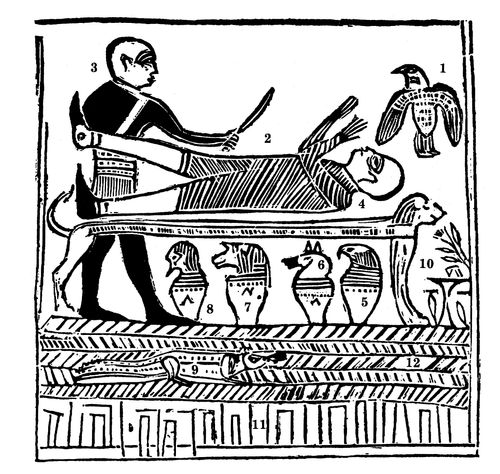
And it came to pass that the priests laid violence upon me, that they might slay me also, as they did those virgins upon this altar… And as they lifted up their hands upon me, that they might offer me up and take away my life, behold, I lifted up my voice unto the Lord my God, and the Lord hearkened and heard, and he filled me with the vision of the Almighty, and the angel of his presence stood by me, and immediately unloosed my bands (Abraham 1:12, 15).
Abram is delivered by the Lord, and the covenants is begun:
And his voice was unto me: Abraham, Abraham, behold, my name is Jehovah, and I have heard thee, and have come down to deliver thee, and to take thee away from thy father’s house, and from all thy kinsfolk, into a strange land which thou knowest not of; And this because they have turned their hearts away from me, to worship the god of Elkenah, and the god of Libnah, and the god of Mahmackrah, and the god of Korash, and the god of Pharaoh, king of Egypt; therefore I have come down to visit them, and to destroy him who hath lifted up his hand against thee, Abraham, my son, to take away thy life. Behold, I will lead thee by my hand, and I will take thee, to put upon thee my name, even the Priesthood of thy father, and my power shall be over thee. As it was with Noah so shall it be with thee; but through thy ministry my name shall be known in the earth forever, for I am thy God (Abraham 1:16-19).
The priest of Elkinah is then smitten so that Abraham is not able to be sacrificed:
Now, after the priest of Elkenah was smitten that he died, there came a fulfilment of those things which were said unto me concerning the land of Chaldea, that there should be a famine in the land. Accordingly a famine prevailed throughout all the land of Chaldea, and my father was sorely tormented because of the famine, and he repented of the evil which he had determined against me, to take away my life (Abraham 1:29-30).
Interestingly, the priest who offers Abraham as sacrifice is not Terah, though the suggestion is here that Terah repented of the evil- is this about his upbringing or is it that he was handed over for the sacrifice? There is no indication in the Pearl of Great Price as to why Terah handed over his son, I like the idea of the rabbinic reasoning, but it might just be the idolatrous nature of Terah. This repentance does not last long however:
…and my father turned again unto his idolatry, therefore he continued in Haran (Abraham 2:5).
These events take on an added importance in the future events of Abraham’s life. We will revisit it in future weeks, but the feelings and struggles of being asked to sacrifice his son in later years must have brought back the wicked practices of his father, and the act to which he was subjected.
Hagar and the birth of Ishmael
As I read the story of Abraham there are bits that my modern sensibilities struggle with. For example we read after getting old and having no children we read:
Now Sarai Abram’s wife bare him no children: and she had an handmaid, an Egyptian, whose name was Hagar. And Sarai said unto Abram, Behold now, the Lord hath restrained me from bearing: I pray thee, go in unto my maid; it may be that I may obtain children by her. And Abram hearkened to the voice of Sarai. And Sarai Abram’s wife took Hagar her maid the Egyptian, after Abram had dwelt ten years in the land of Canaan, and gave her to her husband Abram to be his wife. And he went in unto Hagar, and she conceived… (Gensis 16:1-4).
I guess the idea is that because Hagar ‘belongs’ to Sarah, if she has a child with Abraham then it will be that she is able to ‘obtain children by her.’ Even at this stage, before what comes next, the question of Hagar’s ability to consent is called into question. The power dynamic is not conducive to her saying ‘no.’ In many ways we gloss over this, and she may well have been happy with the situation, but it is hard to know from the biblical record, and one has to just accept the events and not really think too deeply. It is interesting that in Islamic teaching Hagar is not a handmaid, but a legitimate wife as she is an Egyptian princess. This seems to be a theme within Jewish rabbinic literature:
Rabbi Shimon ben Yoḥai said: Hagar was Pharaoh’s daughter. When Pharaoh saw the [miraculous] acts that were done on Sarah’s behalf in his palace, he took his daughter and gave her to him [Abraham]. He said: ‘It is preferable that my daughter be a maidservant in that household than be the mistress in another household.’ That is what is written: “And she had an Egyptian maidservant, and her name was Hagar” – here is your reward [ha agrikh]. Avimelekh, too, when he saw the miracles that were performed on Sarah’s behalf in his palace, he took his daughter and gave her to him. He said: ‘It is preferable that my daughter be a maidservant in that household than be the mistress in another household.’ That is what is written: “The daughters of kings are among those who honour you; at your right hand stands the consort, attired in gold from Ofir” (Psalms 45:10) (Bereshit Rabbah 45).
It would appear in such an approach that her status is less lowly, though the literature also records her actions when pregnant. Returning to verse 4:
And he went in unto Hagar, and she conceived: and when she saw that she had conceived, her mistress was despised in her eyes.
The midrash suggest:
Noblewomen would come and inquire after Sarah’s wellbeing, and Sarah would say: ‘Go and inquire after the wellbeing of that meek woman’ [Hagar]. Hagar would say to them: ‘My mistress Sarah, her inner reality is not like her outward impression. She gives the impression of being a righteous woman, but she is not a righteous woman. Were she a righteous woman, look at how many years that she did not conceive, whereas I conceived in one night.’ Sarah would then say: ‘Should I have a discussion with this woman? Better that I should have a discussion with her master.’
It is suggested that it is for this reason that Sarah treated her harshly so that Hagar fled:
“Sarai treated her harshly, and she fled from her” – Rabbi Abba bar Kahana said: She prevented her from engaging in conjugal relations. Rabbi Berekhya said: She hit her in the face with a slipper. Rabbi Berekhya in the name of Rabbi Abba bar Kahana: She made her take buckets and towels to the bathhouse for her.
Being met by an angel it is recorded that she was commanded:
And the angel of the Lord said unto her, Return to thy mistress, and submit thyself under her hands. And the angel of the Lord said unto her, I will multiply thy seed exceedingly, that it shall not be numbered for multitude (Genesis 16:9-10).
There is a question as to why the Lord would want her to submit to ill-treatment. The importance of her son in salvation history and the covenant more widely will be interesting to explore as we move into future weeks. That this was important is shown in Latter-day revelation:
God commanded Abraham, and Sarah gave Hagar to Abraham to wife. And why did she do it? Because this was the law; and from Hagar sprang many people. This, therefore, was fulfilling, among other things, the promises (D&C 132:34).
I’m not sure what I’m taking form this, but it helps me to think it through- not to justify actions but to realise that not all of our actions are always completely in harmony with the Lord.
 jamesdholt.com