I love Christmas!
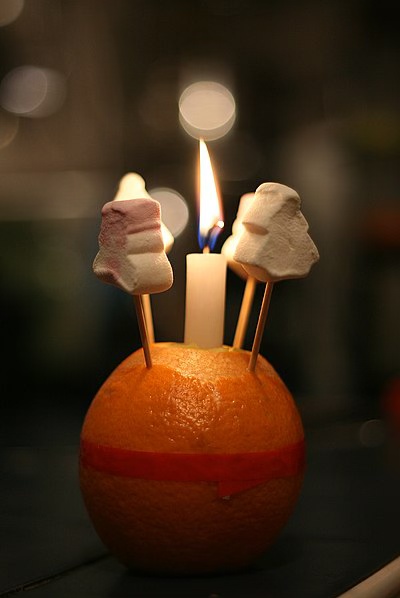
One of my earliest ‘religious’ memories is of Christmas when I was about five or six years of age. On Christmas Eve my mum took my brother and me to a Christmas Eve service at the local Church, where we held Christingles. Maybe this sticks in my mind because there is a photo of me holding the Christingle when I got home. Whenever I explore the teaching of Christianity with my students the Christingle is something that I revisit.
There is much imagery to be found within this simple object. The orange represents the world; while the red ribbon wrapped around the world represents the blood and love of the Saviour, as his sacrifice enables the world to be saved. The cocktail sticks with fruits or sweets are either reminders of the fruits of the earth, or the four corners of the world to which the Saviour’s love reaches. Most obvious of all is the candle that stands proudly in the top of the orange. This is a reminder that the Saviour has declared himself to be ‘the light of the world’ (John 8:12).
As I have studied the Saviour’s life recently, and also as I have reflected on different aspects of the world into which he came, I have come to understand a little bit more the importance of his statement.
In the Old Testament, and more widely in Judaism, light is a symbol of the presence of God. This is shown particularly in the Temple of ancient Judaism where a menorah was lit to symbolise his presence. This light was to always burn as a reminder to worshippers that God always dwelt with them. The Hebrew word for the presence of the Lord is ‘shechinah’ – it means to ‘dwell’ or ‘settle’ and refers to the idea that God can focus his presence in one place (while still maintaining his omnipresence). Examples in the Torah include Genesis 3:8 (the Garden of Eden) and Exodus 25:8 (the portable tabernacle). It is also the idea behind the building of the Temple. So important is this light that burned in the Temple that an event in Jewish history reminds us of God’s miraculous intervention in our lives.
During the Second Century BCE the Maccabean revolt (freed Judea and Jerusalem from the rule of the Seleucid Empire, and more particularly it enabled the Second Temple to be rededicated. Antiochus IV Epiphanes invaded Jerusalem and “came upon the Jews with a great army, and took their city by force, and slew a great multitude… and sent out his soldiers to plunder them without mercy. He also spoiled the temple, and put a stop to the constant practice of offering a daily sacrifice of expiation for three years and six months” (Josephus, 1999, 670). Antiochus outlawed Judaism and subjugated the Jews and traditions. In 167BCE he “compelled the Jews to dissolve the laws of their country, and to keep their infants uncircumcised, and to sacrifice swine’s flesh on the altar” (Josephus, 1999, 670), and ordered an altar dedicated to Zeus be built in the Temple.
This was not taken well by the Jews, and Mattathias, , along with his five sons Johanan, Simeon, Eleazar, Jonathan and Judah (later known as Judah HaMakabi “Judah the Hammer”) led a rebellion against Antiochus and his occupying force. In 166BCE Matthatias died, and Judah began to lead the rebellion. In 164BCE the rebellion was successful despite the Jewish armies being vastly outnumbered, the Temple was retaken and rededicated. The Maccabees removed the idol of Zeus at New Year, and the desecrated altar was also removed. In rededicating the Temple, Maimonides explains:
When the Jews overcame their enemies and destroyed them, they entered the Sanctuary; this was on the twenty-fifth of Kislev. They could not find any pure oil in the Sanctuary, with the exception of a single cruse. It contained enough oil to burn for merely one day. They lit the arrangement of candles from it for eight days until they could crush olives and produce pure oil (Mishneh Torah, Scroll of Esther and Hanukkah 3:2).

There was only enough oil for the menorah to burn for one day, but miraculously it lasted for eight. The suggestion is that so important is the presence of the Lord in a person’s and a community’s life that the Lord enables us to be blessed with his light and his presence when the circumstances seem to be against us.
What does this have to do with the Saviour being the light of the world? As I have studied the scriptures I have been surprised at the number of times that dwelt or dwelling. In John 1:14 it describes the Saviour in the following way: ‘The Word became flesh, and dwelt among is’. For me, this is the idea that God, in the person of Jesus, is the physical manifestation of shekinah. That God came to dwell among us in the person of Jesus. If we are ever in darkness or despair, then we understand that the light, or our hope is the Saviour. This reminds me of the First Vision account of Joseph Smith:
After I had retired to the place where I had previously designed to go, having looked around me, and finding myself alone, I kneeled down and began to offer up the desires of my heart to God. I had scarcely done so, when immediately I was seized upon by some power which entirely overcame me, and had such an astonishing influence over me as to bind my tongue so that I could not speak. Thick darkness gathered around me, and it seemed to me for a time as if I were doomed to sudden destruction. But, exerting all my powers to call upon God to deliver me out of the power of this enemy which had seized upon me, and at the very moment when I was ready to sink into despair and abandon myself to destruction—not to an imaginary ruin, but to the power of some actual being from the unseen world, who had such marvelous power as I had never before felt in any being—just at this moment of great alarm, I saw a pillar of light exactly over my head, above the brightness of the sun, which descended gradually until it fell upon me. It no sooner appeared than I found myself delivered from the enemy which held me bound (JSH 1:15-17).
Finding himself overcome with darkness, Joseph was delivered by the light, and within the light was the Saviour. This is so with our lives. Whatever challenges we are facing, He is the light, that will deliver us from the seeming hopeless darkness that we find ourselves in.
The Saviour describes himself as the light of the world in John chapters 8 and 9, in these chapters we also read of the healing of the blind man. It is no surprise that that a man who lived his life in darkness, was able to see through the light of the world. In this story it describes the events in this way:
And as Jesus passed by, he saw a man which was blind from his birth. And his disciples asked him, saying, Master, who did sin, this man, or his parents, that he was born blind? Jesus answered, Neither hath this man sinned, nor his parents: but that the works of God should be made manifest in him. I must work the works of him that sent me, while it is day: the night cometh, when no man can work. As long as I am in the world, I am the light of the world. When he had thus spoken, he spat on the ground, and made clay of the spittle, and he anointed the eyes of the blind man with the clay, And said unto him, Go, wash in the pool of Siloam, (which is by interpretation, Sent.) He went his way therefore, and washed, and came seeing (John 9:1-7).
This seems very straightforward ‘He went his way… and washed, and came seeing”. Many of you will know that I am completely blind in my left eye. I was told when I was a teenager that even if they developed the expertise to unfold the retina, I would still not be able to see because my brain had spent over 15 years ignoring any messages or not even receiving them. When the blind man was healed, it was not just the eye that was changed, but the brain and neural system of the man. That is how the Lord works with us, he changes us inside and out. He enables us to find a higher joy in life. For me, this is another part of Jesus being the light of the world; he does not just show us the way, or point us in the right direction, he changes who we are from the inside out, so that we are transformed into people who reflect his light.
This is brought home to me in John chapter 1. We read:
In him [meaning the Saviour] was life; and the life was the light of men. And the light shineth in darkness; and the darkness comprehended it not (John 1:4-5).
People in the world do not necessarily know who the Saviour is, they may know his name but do they understand his mission and his ability to transform us into new creatures and become all we are meant to become? John chapter 1 continues:
There was a man sent from God, whose name was John. The same came for a witness, to bear witness of the Light, that all men through him might believe. He was not that Light, but was sent to bear witness of that Light. That was the true Light, which lighteth every man that cometh into the world. He was in the world, and the world was made by him, and the world knew him not (John 1:6-10).
We, too, serve a John the Baptist like purpose in pointing people towards the Saviour, to bear witness of the Light who is the Alpha and the Omega, the beginning and the end, and everything in between. The Saviour reminds us of this in the Sermon on the Mount:
Ye are the light of the world. A city that is set on an hill cannot be hid. Neither do men light a candle, and put it under a bushel, but on a candlestick; and it giveth light unto all that are in the house. Let your light so shine before men, that they may see your good works, and glorify your Father which is in heaven (Matthew 5:14-16).
We are to be the light of the world, in the way that we point people to the Saviour. We become the light through which others can see the light of the Saviour; we are merely reflections of Him, to point people to Him. I remember listening to Julie De Azvedo speak about her song, Window to His Love. She spoke about a time where she had been placing herself between others and their view of the Saviour, she had become a door. She realised that she needed to become a window to His love, so that others could praise Him and draw close to Him.
How do we do this? We make sure that we give credit to the Lord in all aspects of our lives. In order for this to be honest, we must be striving to live as disciples of Christ. Through our discipleship as we seek to align our beliefs and behaviour we are able to help people to see the light of the Saviour, and not become, as Alma describes, ‘stumbling blocks’ to those outside of the Church. As we reflect on our lives, it is important to reflect on whether we are providing a window through which others can experience and see the Saviour, or a door which blocks their view as suggested by Julie De Azvedo.
Whenever I think of people seeing Christ in our lives, I am reminded of Alma chapter 5, where Alma asks the question:
And now behold, I ask of you, my brethren of the church, have ye spiritually been born of God? Have ye received his image in your countenances? Have ye experienced this mighty change in your hearts? Do ye exercise faith in the redemption of him who created you? Do you look forward with an eye of faith, and view this mortal body raised in immortality, and this corruption raised in incorruption, to stand before God to be judged according to the deeds which have been done in the mortal body? (Alma 5:14-15).
Hopefully we can all say yes, but the far more telling question comes later in the chapter:
And now behold, I say unto you, my brethren, if ye have experienced a change of heart, and if ye have felt to sing the song of redeeming love, I would ask, can ye feel so now? Have ye walked, keeping yourselves blameless before God? (Alma 5:26-27).
Our conversion to, and acceptance of, the Saviour is not a one time event. It is something that in an ongoing process within our lives that we develop and recapture every day of our lives. We are called to be everyday disciples of the Saviour, rather than what, Neal A Maxwell calls, ‘weekend warriors’. Every day we must evaluate our discipleship and how we are drawing close to the Saviour, and make any corrections that may be necessary, so that we can always be that light that can show the way to the Saviour.
For me, this is taught beautifully in the hymn, Brightly Beams Our Father’s Mercy. I have to give credit at this point to Ruth, who introduced me to this story. The story behind this hymn surrounds events in the Cleveland Harbour in the nineteenth century. The first verse begins:
Brightly beams our Father’s mercy
From his lighthouse evermore…
In the harbour, as in life there was the constant of the light from the lighthouse. This is an ever present in our lives if we open our eyes to see it. This, in the story of the harbour identified where the harbour was, and to be watchful as people draw close to the light. However, as in the harbour so in life, there is not only the lighthouse. There are the lower lights:
But to us he gives the keeping
Of the lights along the shore.
The lower lights should have been burning at the harbour mouth, to guide the ships safely in. Without the lower lights the risks are greater, and the likelihood of a shipwreck are significantly increased. The chorus highlights the imagery and symbolism of this:
Let the lower lights be burning;
Send a gleam across the wave.
Some poor fainting, struggling seaman
You may rescue, you may save.
As disciples of Jesus Christ, we are those lower lights to guide others safely into the harbour. We do this by showing the love of the Saviour in our lives, and living every day as His disciples.
As I consider Christ as the light of the world and our responsibility to reflect that light I am led to ask myself the question, how often am I recharging and shining that light?
As I prayed about what I should share today my thoughts obviously turned to Christmas, and then the idea of Jesus as the Light of the World. Christmas is the festival of light. The celebration of his Incarnation, when Word became flesh” and dwelt among us. As I celebrate this time, I return again to six-year-old Jimmy who held that Christingle so tight. I’m not sure that I understood anything about my Saviour at that point, but 45 years later I more fully understand who he is and also a little bit more of who I am. I understand have a responsibility today to light the world! We do that little by little by showing the grace and the love that we have received. We read in the nativity story in Luke:
And they came with haste, and found Mary, and Joseph, and the babe lying in a manger. And when they had seen it, they made known abroad the saying which was told them concerning this child. And all they that heard it wondered at those things which were told them by the shepherds… And the shepherds returned, glorifying and praising God for all the things that they had heard and seen, as it was told unto them (Luke 2:16-18,20).
They received the good news of the Saviour’s birth and then they made known abroad everything they had seen or heard.. Just as the Christingle shines his light, through the red ribbon it also reminds us of his love and sacrifice for us and our responsibility to make this known. At this Christmas season, and hopefully every day of my life, I want to share the good news of the light of the world
I know that Jesus Christ is my Saviour.
I know that he is the Son of God.
I know that through him I am redeemed.
I know that through him my sins are forgiven.
I know that through him I am changed.
I know that through him I am strengthened.
I know that through him I can receive eternal life.
I know that through him I have joy in my life.
I know that through him my family relationships are eternal.
I know that through him I understand who I am.
I know that through him I am loved.
I know that through him I understand I have a responsibility to share his love.
I know that through him I am and will be.
I love him because he loved me first.
 jamesdholt.com