The below are adapted remarks from a lecture given at Chester Festival of Ideas on 2 July, 2026
Introduction
Good afternoon, and thank you for being here.
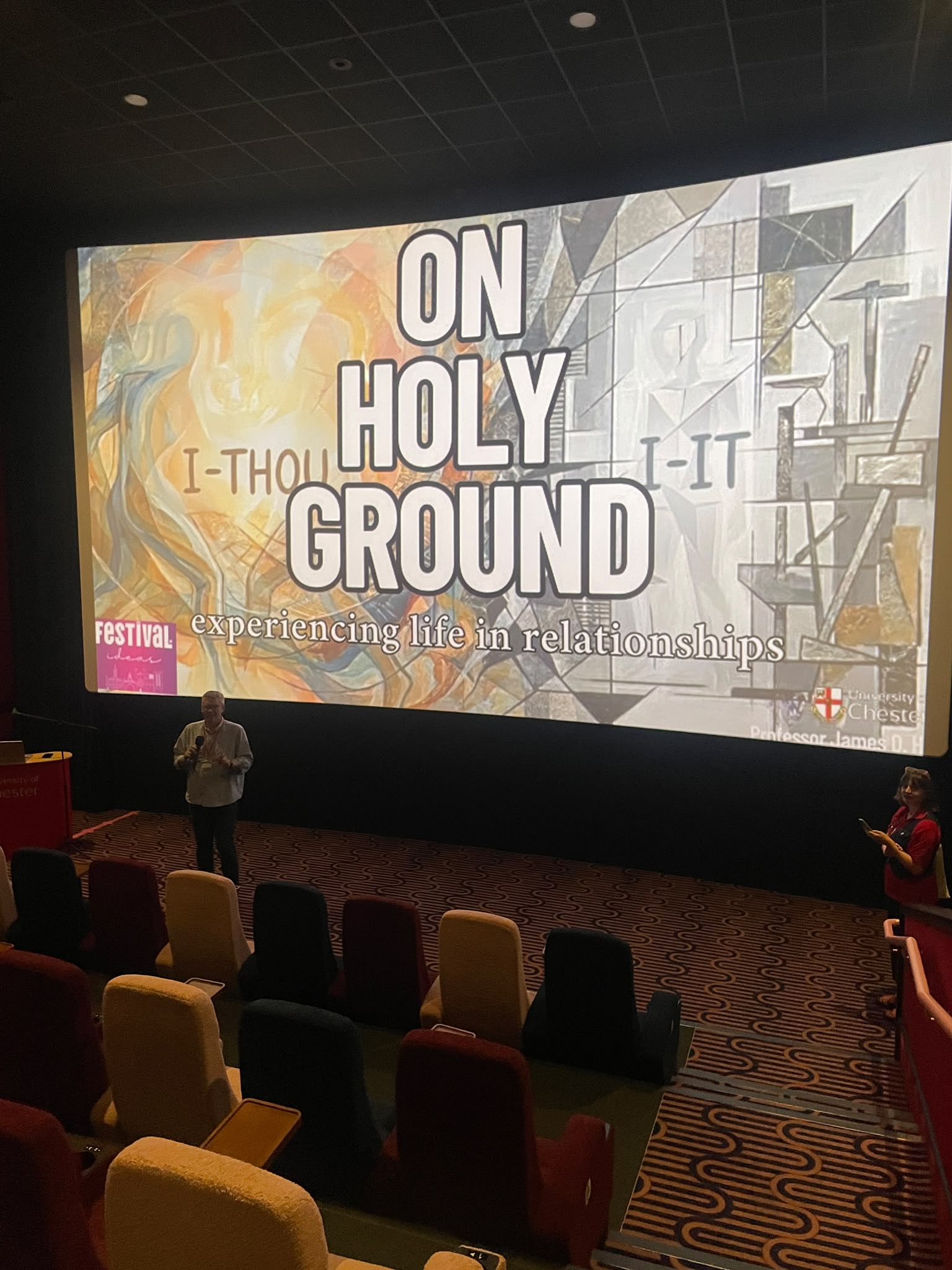
My name is James Holt, and I am Associate Professor of Religious Education at the University of Chester. My professional role centres on the education and training of teachers, particularly those entering the field of Religious Education.
I am delighted to have the opportunity to speak with you today about a subject that has become increasingly important in my own life and work: the significance of relationships and our interconnectedness with one another. Specifically, I want to consider what it means to live in genuine relationship with one another in a world that often appears increasingly fragmented and divided.
To begin, I would like to share one of my favourite sculptures, The Cathedral by Auguste Rodin. When people first encounter this sculpture, they are often invited to recreate its shape with their own hands. Most discover relatively quickly that it is impossible to do so alone; the sculpture requires two people.
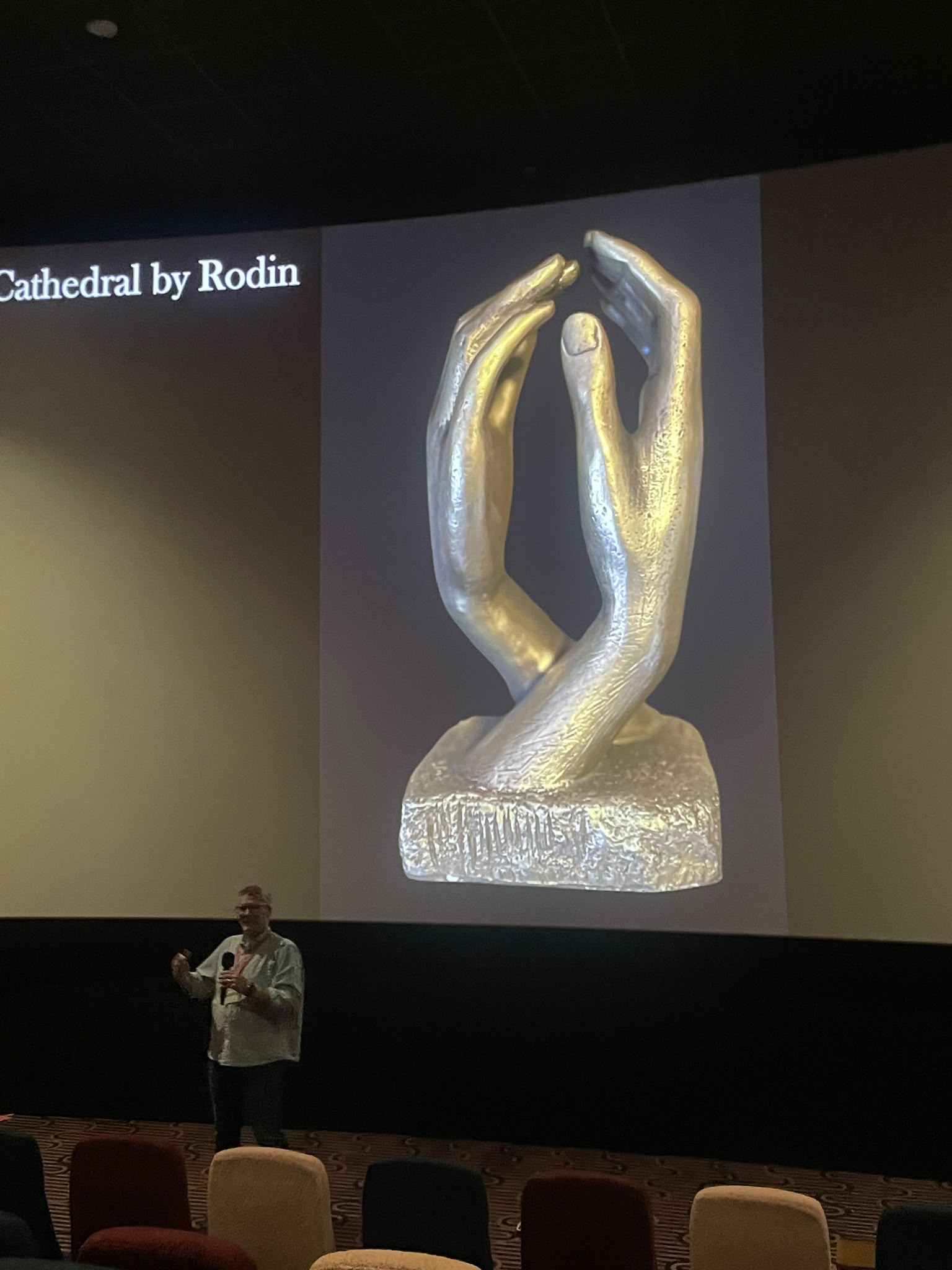
For me, this serves as a powerful metaphor for modern life. We are often encouraged to be independent, self-sufficient and self-reliant. We receive a challenge and immediately attempt to solve it alone. Yet many of life’s most meaningful achievements and deepest experiences emerge not through isolation, but through relationships.
This realisation has become increasingly significant to me over time. For much of my life, I regarded myself as largely self-sufficient. My family, my wife and children, provided everything I believed I needed. Yet the experience of the COVID-19 pandemic challenged that assumption. It reminded me that, beyond our immediate families, we depend upon wider networks of relationships: colleagues, friends, members of our faith communities, neighbours, and countless others who contribute to our sense of belonging and wellbeing. Human beings are relational creatures.
Consequently, relationships have become central to both my personal outlook and my professional practice.
Why Relationships Matter
One of my favourite observations about education comes from James Comer, who stated:
No significant learning can take place without a significant relationship.
This insight highlights three interconnected dimensions of education.
First, there is the relationship between teachers and students. Second, there is the relationship students develop with one another. Third, there is the relationship that learners establish with the subject matter itself. Learning is not merely the transmission of information; it is fundamentally relational. Genuine engagement emerges when individuals form meaningful connections, with people, ideas, and experiences.
My own teaching career demonstrates this rather well. I have always been passionate about Religious Education. It is a subject I care deeply about. Earlier in my career, however, I also taught Geography. If I am being entirely honest, I was probably one of the world’s least effective geography teachers. The reason was simple: I lacked the same enthusiasm for the subject. At one point I discovered that I did not even know what a fumarole was. Apparently, it is a volcanic vent. My geography students deserved considerably better. Effective teaching requires more than knowledge; it requires genuine engagement.
The point is simple: relationships create engagement. We learn better when we connect. We teach better when we care. Relationships shape every aspect of human experience.
No One Is an Island
Today, therefore, I would like to explore how relationships shape our lives, our communities, and our understanding of the world. My aim is not to provide guidance on personal relationships in the conventional sense, but rather to examine the broader role that relationships play in human flourishing and social cohesion.
William Paul Young captures this beautifully in The Shack when he writes:
It’s simple, Mack. It’s all about relationships and simply sharing life. What we are doing right now− just doing this− and being open and available to others around us. My church is all about people and life is all about relationships (Young, 2008: 178).
Whether or not one approaches this statement from a religious perspective, it captures something profoundly important about the human condition. We do not exist in isolation. As the poet John Donne famously observed:
No man is an island, entire of itself.

Human beings do not exist in isolation. Each of us is connected to others through social, cultural, economic, political, and spiritual relationships. The experiences of one person inevitably affect the wider community. Our lives are connected in countless ways, and our wellbeing is inevitably bound up with the wellbeing of others. Yet despite living in an era of unprecedented communication and connectivity, many would argue that we are simultaneously experiencing increasing social division. Understanding this paradox lies at the heart of today’s discussion.
Living in an Increasingly Divided World
Despite living in the most connected period of human history, we often appear more divided than ever before. We communicate instantly across continents, maintain relationships across borders, and have access to unprecedented information. Yet social, political, cultural and religious divisions often seem increasingly pronounced.
Much of contemporary public discourse focuses on difference rather than commonality.
Social media can amplify division. Political debate increasingly rewards confrontation over understanding. Religious identities, cultural differences and ideological disagreements are often presented as barriers rather than opportunities for learning.
This concern was reinforced for me during a recent visit to Manchester with student teachers. We visited a synagogue, a mosque, a gurdwara and a Christian chapel. These were students who had already spent years studying religion academically. Yet many of them commented that they learned more about faith communities during that single day of encounter than they had through months of classroom study.
Why?
Because they encountered real people rather than abstract concepts. They heard stories. They asked questions. They saw how beliefs were lived rather than merely described. Encounter transformed understanding.
Beyond Tolerance
Tolerance is often presented as a social ideal. Yet tolerance represents only the minimum requirement for peaceful coexistence. It implies: “You remain over there, and I will remain over here. We disagree, but we will avoid conflict.”
There may be no hostility, but neither is there genuine engagement. We coexist, but we do not connect. Relationships require more than passive acceptance; they require engagement.
Relationships require something more than tolerance. They require curiosity. They require humility. They require conversation. Most importantly, they require a willingness to see another person not as a problem to be solved but as a human being to be understood. Therefore, the goal should not simply be tolerance but encounter, dialogue, and mutual understanding.
Martin Buber: I-It and I-Thou

The Jewish philosopher Martin Buber provides a powerful framework for thinking about relationships.
Buber distinguishes between two ways of relating to the world: I-It and I-Thou relationships.
An I-It relationship treats another person as an object. The other becomes a means to an end, a service provider, a resource, or a commodity. Such relationships are transactional and instrumental. People are valued primarily for what they can provide. This can happen more often than we would like to admit. Many of us have probably found ourselves saying to our children, “I am not your service provider.” My own mum frequently reminded us that we treated the house like a hotel. Perhaps many of us have heard similar observations.
An I-It mentality also shapes how we interact with the natural world. The environment becomes something to consume rather than something with which we exist in relationship.
A particularly striking illustration emerged for me through my own experience of weight loss. Over the course of a year, I lost a considerable amount of weight and was required to rethink my relationship with food. I discovered that many of my eating habits were not driven by genuine hunger. They were learned behaviours, conditioned responses to routine and environment. It reminded me how much of our behaviour, including consumption, is shaped by the culture around us.
The second type of relationship is I-Thou.
By contrast, an I-Thou relationship recognises the full humanity of the other person. Here the individual is encountered not as an object but as a person possessing dignity, value, and intrinsic worth.
This distinction extends beyond human relationships. Buber also invites us to consider how we relate to the natural world. Do we see nature merely as a resource to be consumed, or as something with which we exist in relationship?
Contemporary consumer culture often encourages an I-It approach. We risk treating both people and the environment as commodities whose primary purpose is to satisfy our wants and needs. Such attitudes contribute to social fragmentation and environmental degradation.
Love as the Foundation of Relationship
Buber’s distinction between I-It and I-Thou relationships raises an important question:
What kind of attitude enables us to encounter another person as a Thou rather than an It?
I would suggest that the answer is love. Now, when we hear the word love, many of us immediately think of romance, attraction or family affection. Important as those forms of love are, they are not what I have in mind here. The ancient Greeks used several words for love, each describing a different aspect of human relationships. There is eros, associated with romantic and physical love. There is storge, which describes familial affection. There is philia, often translated as friendship or brotherly love. Then there is agape. It is this final form of love that is particularly important for our discussion today. Agape is not based upon attraction, family ties or personal preference. It is a love grounded in recognising the inherent worth and dignity of another person. It is a love that asks not, “What can this person do for me?” but rather, “How should I respond to this person as a fellow human being?” This distinction is crucial because it transforms how we think about relationships.
If I only love those who are like me, who agree with me, who belong to my family, my community or my social group, then my capacity for connection remains limited. Agape invites something far more challenging. It asks us to recognise the humanity of people whose beliefs differ from our own, whose political views frustrate us, whose lifestyles we may not understand and even, perhaps, those whom we find difficult to like.
One of the observations we often make is this:
We do not have to like everybody, but we can choose to love everybody.
That statement usually provokes a reaction because we all have people we find difficult. Yet love, in this sense, is not an emotion. It is a disposition. It is a commitment to treat another person with dignity and compassion regardless of how we feel about them. This is why love sits at the centre of so many religious traditions.
Within Christianity, the Apostle Paul famously describes love as patient, kind, humble and enduring. Jesus’ command to “love your enemies” is perhaps one of the most radical ethical teachings ever expressed because it extends moral concern beyond those who naturally attract our affection. Yet this principle is not uniquely Christian.
Across religious traditions we encounter similar ideas. We find calls to compassion, mercy, service and concern for the welfare of others. Whether expressed through Sikh teachings on selfless service, Islamic teachings on compassion, Jewish commitments to justice, or broader humanistic traditions, a common thread emerges: our shared humanity creates responsibilities towards one another. Love therefore becomes the antidote to the culture of division. Division asks:
“How are you different from me?”
Love asks:
“What do we share?”
Division seeks boundaries. Love seeks connection. Division turns people into categories. Love restores them as human beings. When I visit faith communities with students, one of the most striking transformations occurs when abstract groups become real people. A Muslim stops being “a Muslim.” A Jew stops being “a Jew.” A Sikh stops being “a Sikh.” Instead, they become Ahmed, Daniel or Hardeev. They become individuals with families, worries, hopes, senses of humour and stories to tell. Love begins when we move from category to person. This is why genuine encounter matters. The purpose of dialogue is not necessarily agreement, the purpose of dialogue is understanding.
Love does not require us to abandon deeply held convictions. Indeed, some of my most meaningful conversations have been with people who fundamentally disagree with me about matters of religion. What love does require is that we continue to recognise the dignity of the person with whom we disagree.
In a society increasingly characterised by polarisation, outrage and suspicion, this may be one of the most important lessons we can recover. Not simply tolerance, not merely coexistence, but a commitment to seeing others as worthy of care, respect and concern. In the language of Martin Buber, it is the movement from I-It to I-Thou. In the language of faith, it is simply love
Learning Through Encounter
Meaningful encounters have the power to transform us. One of my favourite examples of this comes from my eldest daughter. Several years ago, she suggested that when someone asks her on a date, she considers not simply whether the relationship might develop romantically, but what she might learn from that person. I remember thinking that this was a remarkably mature approach. The relationship itself may not become anything significant, but every encounter offers an opportunity for learning, growth and transformation.
Drawing upon the work of Homi Bhabha, we may think of this as the creation of a “third space”—a space that emerges when two individuals, traditions, or perspectives come into dialogue.
In these encounters, both participants may be changed. Barbara Brown Taylor expresses this beautifully:
I asked God for religious certainty, and God gave me relationships instead. I asked for solid ground, and God gave me human beings instead—strange, funny, compelling, complicated human beings—who keep puncturing my stereotypes, challenging my ideas, and upsetting my ideas about God, so that they are always under construction.
This process occurs whenever we genuinely engage with ideas different from our own. A book, a conversation, a friendship, or a visit to another community can challenge our assumptions and broaden our understanding. Through encounter, stereotypes are broken down and deeper understanding develops.
Relationships disrupt certainty and challenge our assumptions. They force us to reconsider stereotypes. They help us understand not only others but ourselves. This is why dialogue matters. The goal of dialogue is not necessarily agreement. Rather, it is understanding. It enables us to appreciate why others hold different beliefs and values while also reflecting more deeply on our own.
A Connected World
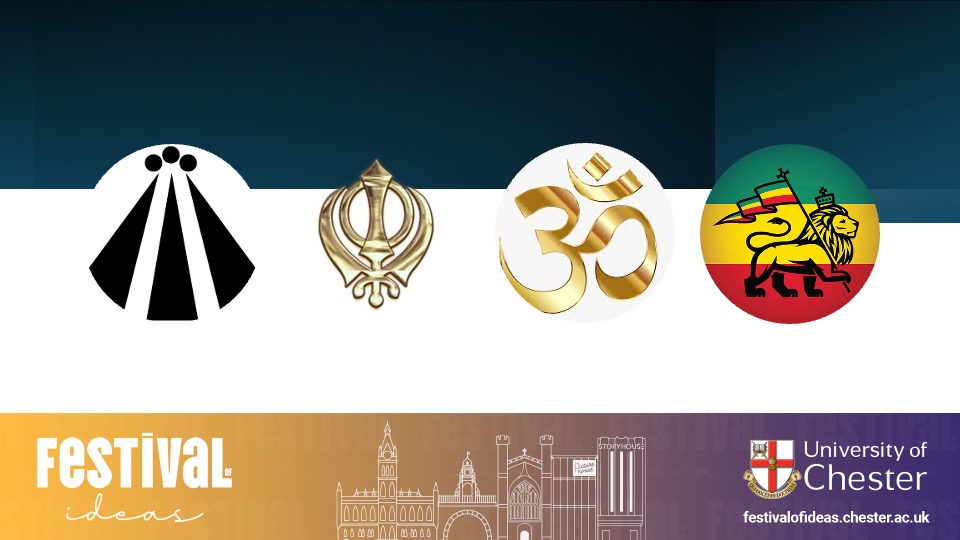
Many religious and philosophical traditions emphasise that life is interconnected. Within Druidry, the concept of Awen speaks of inspiration and spiritual energy flowing through all existence. Awen is a Welsh word that generally means ‘poetic spirit’ or ‘flowing inspiration’. It flows throughout everything, through humanity and also through all of the natural world. It is the inter-connectedness of everything; Joanna van der Hoeven has explored Awen and how it can find expression in life. She suggests that it is an awareness of the “entirety of existence” and as such:
It is seeing the threads that connect us all. It is the deep well of inspiration that we drink from, to nurture our souls and our world and to give back in joy, in reverence, in wild abandon and in solemn ceremony (2014, p. 20).
This interconnectedness of all living things inspires a deep reverence for, and a desire to live in concert with, the natural world. Van der Hoeven provides a further example of how this might find expression in a Druid’s consciousness:
When out walking in the forest, we can lose our sense of self in order to become the forest. Once we are in the forest we are able to drink deeply from the flow of awen that is all life around us. We become the trees, the deer, the fox, the boulder, the streams and the badger. We can learn so much from this integration. When we are fully immersed in simply ‘being’, we are fully in the flow of awen. Our footsteps become lighter, our passage becomes barely noticeable (van der Hoeven, 2014, p. 21).
This reverence for, and oneness with, nature enables the Pagan to have a deep respect for every living thing. Awen also moves a person with compassion for all that they find around themselves and is a reflection of the awareness that imbues the flow of nature and the world
Similar ideas can be found in Sikhi, Hinduism, Rastafari traditions, and Indigenous worldviews.
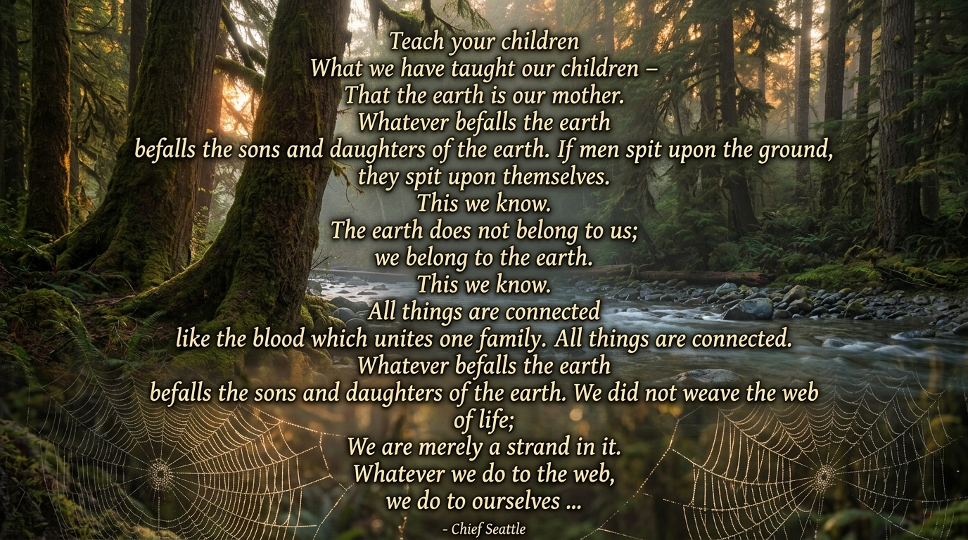
Chief Seattle famously expressed this understanding when he wrote:
Teach your children
What we have taught our children –
That the earth is our mother.
Whatever befalls the earth
befalls the sons and daughters of the earth. If men spit upon the ground,
they spit upon themselves.
This we know.
The earth does not belong to us;
we belong to the earth.
This we know.
All things are connected
like the blood which unites one family. All things are connected.
Whatever befalls the earth
befalls the sons and daughters of the earth. We did not weave the web of life;
We are merely a strand in it.
Whatever we do to the web,
we do to ourselves … (Smith, 1887, p. 3).
Such perspectives challenge human-centred assumptions and encourage a more relational understanding of the world. We are not separate from nature; we are part of it. Our actions toward the environment ultimately affect ourselves and future generations.
Martin Luther King and Social Responsibility
Martin Luther King Jr., one of my personal heroes, repeatedly emphasised the interconnected nature of human life.
He stated:
In a real sense all life is interrelated. The agony of the poor enriches the rich. We are inevitably our brother’s keeper because we are our brother’s brother. Whatever affects one directly affects all indirectly (King 1967: 181).
The suffering of one part of society inevitably affects the whole. Injustice cannot remain isolated forever. The wellbeing of others is not someone else’s concern, it is our concern. The same lesson appears in Martin Niemöller’s famous reflection on the rise of Nazism. His warning reminds us that silence in the face of injustice eventually threatens everyone.
Human flourishing requires solidarity, empathy, and a recognition of our shared responsibility toward one another. This principle lies at the heart of social responsibility. If we genuinely accept that we live in relationship with one another, indifference ceases to be a viable option.
Rethinking Success and Community
Too often, society encourages us to imagine life as a ladder. Success becomes a process of personal advancement in which individuals compete to reach the top.
An alternative vision is offered by Chieko Okazaki through the image of a cat’s cradle:
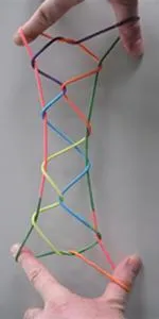
This particular cat’s cradle pattern is called four-eyes. Do you see how complex and beautiful it is? Do you see how each part supports the other parts and is connected to them? You cannot pick one part out without destroying the whole pattern. It is the same with our lives. We meet many people. With some, the association lasts for years. With others, the association is very brief. But in either case, we can make the pattern a beautiful one by making our encounter a kindly one, filled with the desire to serve (Chieko Okazaki).
Here, life is understood as an interconnected network in which each strand supports the others. This image captures an important truth. Our wellbeing depends not solely on individual achievement but on the quality of the relationships we cultivate. Communities thrive when people support one another and recognise their mutual dependence.
So what?
Human beings are fundamentally relational. We flourish not in isolation but through meaningful engagement with others. Relationships have the power to challenge stereotypes, deepen understanding, transform perspectives, and strengthen communities. The obvious next question is this:
So what? How should we respond?
The truth is that none of us can solve every problem facing society. We cannot end political polarisation overnight. We cannot remove every source of conflict and division. However, we can change how we relate to others. We can choose dialogue over dismissal. We can choose understanding over stereotyping. We can choose engagement over indifference. We can choose to listen.
A story told by Stephen Covey captures this well. He described a conversation in which the other person paused before responding. What struck him was that the individual had genuinely been listening rather than simply preparing their next reply. That is often harder than it sounds.
Another challenge arises from the existence of echo chambers. I experienced this vividly during the Brexit referendum. Looking at my social media feeds, I was convinced that almost everyone intended to vote one way. The result was a reminder that many of us inhabit carefully curated environments where we encounter people who already think like us.
Breaking out of those spaces requires intentional effort. It requires engaging with people whose viewpoints differ from our own and doing so respectfully.
Conclusion
I would like to conclude with a story.
A beach is covered with thousands of stranded starfish. A passer-by notices someone throwing them back into the sea one at a time. “Why are you doing that?” he asks. “There are far too many. You cannot possibly make a difference.” The person bends down, picks up another starfish, throws it into the water, and replies: “It made a difference to that one.”
That story captures the central message of this lecture. We may not be able to change the entire world but we can choose how we relate to the people around us. In doing so, we create the possibility, not of a perfect society, but of a more connected, compassionate and humane one.

